















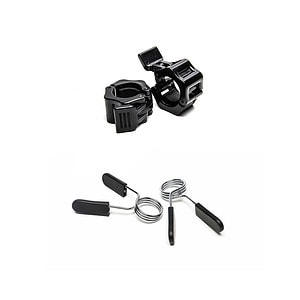
Disc retainers secure bumpers and plates to the barbell during the clean, snatch, back squat and bench press, preventing them from slipping, which could compromise the lift’s trajectory and the athlete’s safety. Sidea manufactures plastic and steel collars for barbells with 28 mm and 50 mm sleeves.
Clamping systems: steel spring, screw-type spin collar, quick-release lock collar
Compatible with 50 mm diameter weightlifting and powerlifting barbells and the 28 mm diameter Pump barbell.
For use with bumper plates and cast-iron plates in CrossFit boxes, weight rooms and home gyms
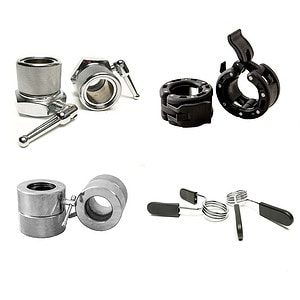
Guida completa: Collar & spring
Barbell Plate Clamps: A Complete Guide
Disc retainers are the components that hold the bumpers and plates in place on the barbell sleeve. They may seem like a minor accessory, but a collar that gives way during a snatch or clean and jerk can cause the discs to slip, throwing the lift off balance and turning a technical session into a safety hazard. Sidea offers six models, including steel spring collars, screw-on spin collars and quick-release lock collars, for barbells with Ø 28 mm (standard) and Ø 50 mm (Olympic) sleeves. Each locking system is designed for a specific use: spring collars are quick to use for general fitness; spin collars remain secure even under the vibration of drops and are the competitive standard; lock collars are the common choice in CrossFit boxes and weightlifting gyms.
What is a disc retainer collar: definition and function
The barbell collar is a locking device that is fitted onto the end of the barbell sleeve after the weight plates have been loaded. Its function is to prevent the weight plates from sliding axially during the movement. In dynamic lifts such as the snatch, clean & jerk or thruster, the vertical acceleration and the impact of the barbell on the floor generate forces that tend to push the bumper plates outwards from the barbell sleeve. Without a suitable collar, the load distribution becomes asymmetrical after just a few repetitions.
The inner diameter of the collar must match that of the sleeve: 28 mm for standard barbells and curl bars, and 50 mm for Olympic barbells. An incorrect fit renders the collar unusable or may damage the sleeve itself.
Types of disc retaining collars
Steel clamp springs
The most traditional system: two handles which, when squeezed between the thumb and forefinger, release the spring to allow insertion. When released, the spring tension locks the collar onto the sleeve. Sidea manufactures the Ø 28 mm spring (SKU 1656) for standard barbells and the Ø 50 mm spring (SKU 9019) for Olympic barbells. They are quick to change between sets, but lose effectiveness if the load is applied impulsively or if the barbell is dropped from a height.
Screw-on spin collar
The collar is screwed onto the sleeve using a threaded knob that tightens an internal clamp. The Spin Collar Ø 50 mm (SKU 9016) and the Olympic Spin Collar Ø 50 mm (SKU 9016/2) fall into this category; the 9016/2 model, in particular, is the standard for weightlifting (WL) and powerlifting (PL) competitions. The locking mechanism is progressive and adjustable, and holds securely even when subjected to vibrations. It takes longer to apply than springs and quick-release levers, so they are preferred in structured training sessions rather than in timed WODs that require rapid load changes.
Quick-release lock collar
The Ø 50 mm Lock Collar (SKU 9016/1) uses a cam lever which, when closed, compresses an internal seal against the sleeve. Open, position, close: two seconds. It is the most widely used system in CrossFit boxes and weightlifting halls because it combines speed with a secure hold during repeated drops.
Pump Bar-specific collar
The Collar Lock Pump Bar Ø 28 mm (SKU 1657) is designed for barbells used in pump classes and for SuperPump rack kit. Quick-release clasp, made of plastic, suitable for the typical loads encountered in group fitness classes.
How to choose: a guide to use cases
Commercial gyms and weight rooms
In a weight room with multiple barbell stations and a mixed-use clientele, the choice is for Ø 50 mm lock collars for the Olympic stations and Ø 28 mm springs for smaller-diameter barbells. Sturdiness and speed of use are essential, as the equipment changes hands constantly.
CrossFit Box
The lock collar is, in fact, the standard. In a WOD involving repeated thrusters, snatches or clean & jerks, a collar that secures with a single lever lock saves precious seconds and, above all, does not give way under the repeated drops of the bumper plates against the technical flooring.
Athletic training programmes
For coaches working on Olympic weightlifting and maximum strength, spin collars offer a more precise and stable lock-in during repeated sub-maximum sets. Speed of adjustment is not the priority: a secure hold is.
Home gyms and garage gyms
If you’re on a tight budget and using them for personal training, a pair of Ø 50 mm springs will cover most strength training exercises. For those who also do Olympic lifting with repeated drops, it’s better to invest directly in a lock collar.
Technical glossary
- SLEEVE
- The rotating end of the barbell onto which weight plates and collars are loaded. The standard diameter is 28 mm for fitness bars and 50 mm for Olympic barbells.
- SPIN COLLAR
- A threaded clamp that is screwed onto the sleeve using a knob. The clamping action is gradual, allowing for fine adjustment of the pressure.
- LOCK COLLAR
- Quick-release collar with cam lever. It combines speed of application with a secure hold under impact loads, such as drops in weightlifting.
- BUMPER PLATE
- A disc coated in hard rubber or polyurethane, designed to be dropped from shoulder or head height without damaging the bar or the floor.
- DROP
- The controlled lowering of the barbell from above towards the floor at the end of a snatch or clean and jerk. This generates vibrations that test the strength of the collar.
- OLYMPIC BAR
- A barbell with sleeves measuring 50 mm in diameter, mounted on bearings or bushings, typically 220 cm long for men and 201 cm for women. Requires 50 mm collars.
- STANDARD BAR
- Barbell with Ø 28 mm sleeves, without independent rotation. Used in group fitness classes and for training with light weights. Requires 28 mm weight collars.
- CAMMA
- An eccentric mechanism that converts the rotary motion of a lever into linear pressure. In lock collars, it compresses an internal seal against the sleeve.
Comparison of Sidea collar models
| Model | SKU | Diameter | Locking system | Recommended use |
|---|---|---|---|---|
| Lock Collar | 9016/1 | Ø 50 mm | Quick-release cam lever | CrossFit box, weightlifting |
| Spin Collar | 9016 | Ø 50 mm | Threaded with a screw | Weight room, fitness training |
| Olympic Spin Collar | 9016/2 | Ø 50 mm | Reinforced screw thread | Olympic weightlifting, technical sessions |
| Pair of steel springs | 9019 | Ø 50 mm | Clamp spring | Home gym, general fitness training |
| Collar Lock Pump Bar | 1657 | Ø 28 mm | Snap lock | Group fitness, pump class |
| Pair of steel springs | 1656 | Ø 28 mm | Clamp spring | Standard barbells, curl bars |
Frequently asked questions about disc-holding collars
Answers to the most common questions about compatibility, sealing, materials and the differences between locking systems are set out in the dedicated FAQ section below.
Why choose Sidea
Sidea has been manufacturing and distributing fitness equipment since 1999 from its headquarters in Gambettola, in Emilia-Romagna. Barbell collars have been part of the barbell range since the very beginning and are supplied to commercial gyms, CrossFit boxes, amateur sports clubs and athletic training centres throughout Italy. As an official StrongFirst distributor and Luxiaojun, Sidea works on a daily basis with certified kettlebell and weightlifting instructors who test the equipment in real-world training scenarios. Pre-sales technical advice helps you choose the correct weight collar based on the type of barbell and the expected frequency of use.
Domande frequenti - Collar & spring
-
The diameter refers to the size of the barbell sleeve onto which the collar is fitted. Olympic weightlifting and powerlifting barbells have sleeves with a diameter of 50 mm and require 50 mm collars. Standard barbells, curl bars and pump class bars have Ø 28 mm sleeves and require specific collars. Using a collar of the wrong size is either impossible or will damage the sleeve.
-
For the snatch, clean & jerk and other lifts involving repeated drops to the floor, the quick-release lever lock collar offers the best combination of hold and speed of application. The screw-type spin collar holds just as well but takes longer to close and open. Clamp springs are the least effective solution under impact loads.
-
For squats, bench presses, deadlifts and movements where the barbell is not released from above, the steel springs hold up well even under heavy loads. They become less reliable when the barbell is subjected to sudden vibrations, such as during Olympic weightlifting drops or high-speed thruster sets.
-
Yes, compatibility depends solely on the diameter of the sleeve. A Ø 50 mm collar fits any standard Olympic barbell, regardless of the manufacturer. Just check that the sleeve falls within the standard dimensional tolerance (49.5–50 mm), a requirement met by virtually all Olympic barbells on the market.
-
You always need two collars per barbell, one on each side. Sidea sells the collars in pairs for this very reason: springs, spin collars and lock collars are supplied as a set of two identical pieces, ready for use on a single Olympic or standard barbell.
-
It depends on the locking system, not on the material itself. Lock collars made of reinforced technopolymer with an internal seal perform exceptionally well under repeated drops because the pressure is generated by the cam mechanism. The holding power of steel springs depends on the elasticity of the metal. In intensive weightlifting contexts, the critical factor is the mechanism, not the alloy.
-
Lock collars and spin collars require periodic cleaning of the locking mechanism to remove magnesite dust and residue that may impair smooth operation. The steel springs must be kept away from prolonged exposure to moisture to prevent rust. No collar requires routine lubrication under normal conditions of use in the weights room.
-
You don’t need a specific collar. A 50 mm lock collar or spin collar will secure both rubber bumper plates and cast iron discs equally well. The difference in use lies in the type of training: bumper plates are used for drop exercises and require impact-resistant collars, whilst cast iron discs in the weight room can also be secured with traditional spring-loaded collars.
-
No. The Collar Lock Pump Bar 1657 is designed for Ø 28 mm sleeves on pump-class barbells and standard bars. An Olympic barbell has Ø 50 mm sleeves and requires 50 mm collars such as the Lock Collar 9016/1, the Spin Collar 9016 or the 9019 springs.
-
Generally speaking, no. Weightlifting and powerlifting barbells are sold without collars, which are regarded as separate accessories because the choice of locking system depends on the intended use. Some rack kits and complete Sidea sets include a pair of springs as standard, but for professional use it is always advisable to choose the collar specifically suited to your operating environment.
-
Sidea offers a range of instalment payment options to make it easier to purchase professional equipment. Please see the dedicated page: Sidea Payment Options.
-
If you work in the fitness or sports sector, register on the website as a Professional or as an ASD to gain access to the price list reserved for industry professionals. Pro registration allows you to view exclusive discounts and special terms across the entire Sidea catalogue.
-
Yes, Sidea is an authorised supplier on the MEPA (Public Administration Electronic Marketplace). Public bodies, schools, universities, local authorities and public sports facilities can purchase Sidea equipment via the Acquisti in Rete PA platform. For information on product codes and direct MEPA orders, please contact Sidea customer service.
-
Sidea guarantees the right to cancel within 14 days of delivery for all online purchases, in accordance with current legislation. Products must be returned undamaged and in their original packaging. For full details on returns, refunds and the warranty, please see the Terms and Conditions of Sale page.
-
Sidea has been designing and distributing professional fitness equipment since 1999: over 25 years’ experience serving gyms, sports coaches, CrossFit boxes, personal training studios and enthusiasts of advanced home fitness. Official distributor for StrongFirst and Luxiaojun, exhibiting at the FIBO international trade fair and technical sponsor of the Summit of Strength. Every product is developed with a focus on durability, functionality and suitability for real-world use. The Gym Design service offers bespoke design with 3D renderings. A warehouse covering over 4,000 m² in Gambettola (FC) ensures rapid order fulfilment, direct technical advice and a special price list for professionals and amateur sports clubs (ASD).
 Defibrillator AED
 Gift CardSidea
 Spare parts