




The Strength Sidea range includes multi-purpose racks, cable stations, powerlifting benches, isotonic machines and hip thrust stations for strength training in commercial gyms, personal training studios and advanced home gyms. Equipment designed for analytical training with heavy loads and maximum strength protocols.
All-in-One Racks and Cable Stations available in modular packs; multi-angle benches, powerlifting racks and dedicated hip thrust stations
Specific machines: Belt Squat, GHD, sissy squat
Guida completa: Strength
Strength: A Comprehensive Guide
Anyone who plans strength training sessions knows that the equipment makes all the difference between a productive training macrocycle and a wasted one. The Strength Sidea range brings together everything you need for optimal strength training: multi-purpose racks, powerlifting racks, cable stations, adjustable benches, and dedicated isotonic machines such as the Belt Squat and hip thrust stations. Thirty products designed for commercial gyms, CrossFit boxes with strength areas, athletic training studios and advanced home gyms. You’ll find specialised solutions for bodybuilding, powerlifting set-ups with IPF-compliant benches, and multi-purpose equipment such as the'All-in-One A rack that combines a squat rack, cable machine and pull-up station in a single unit.
What is the ‘Strength’ category: definition and function
The term ‘Strength’ refers to the range of equipment used for strength training with resistance, both in an isolated form (isotonic machines with guided resistance) and in a full-body form using free weights. It includes racks, benches, cable stations and single-joint or multi-joint machines.
The practical distinction in the weights room is clear. On the one hand, there is the equipment for free-weight training — barbells, rubber-coated plates, benches and racks — which require technique but allow for profound neuromuscular adaptations. On the other hand, guided machines and cable machines are useful for supplementary work, muscle isolation, managing fatigue during rehabilitation or cutting phases, and for users who need to train safely without a spotter.
Types of Strength Equipment
Multifunction and All-in-One racks
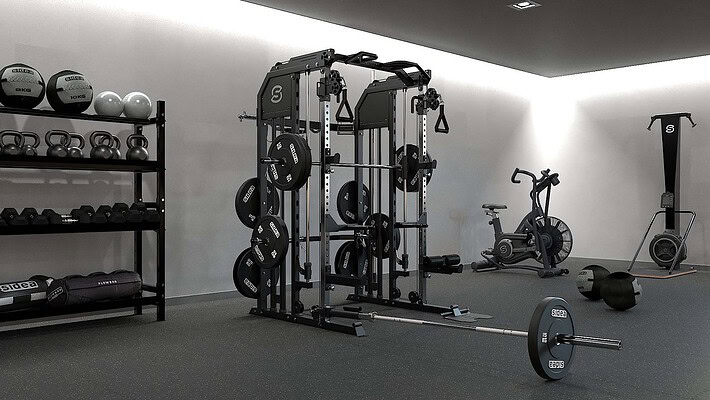
These are all-in-one units that combine a squat rack, a cable machine, plate storage and a pull-up station. The'Premium All-in-One Rack (9088) and the basic 9080 model are designed for gyms wishing to maximise floor space: one user works at the rack, a second at the cable machines, with height-adjustable pulleys. There are also various pre-configured packages available, such as: Light, Full Optional and 360 (which adds a lat machine), but the stations can be customised to suit specific needs, for example by adding a low row, land mine and accessory bars.
Dedicated cable stations
La Cable Station Premium (9089A) and the Crossover, Smart, Bench Pro and Rack variants feature double pulleys with 1:1 and 2:1 ratios. These are useful in personal training studios and fitness centres where the cable is used for the 80% range of auxiliary exercises: high pulley, low row, pallof press and face pull.
Bench Press and Powerlifting
The Powerlifting Rack (9045) and the Flex Bench (9017) meet the specific needs of those who train in the three lifts. Featuring an IPF-style flat bench, a rack with J-cups and safety pins adjustable to the nearest millimetre, and a catch bar for spotter-free training, the 9045 represents the pinnacle of competition racks. The Flex Bench 9017 offers the widest possible range of working angles a user could ask for from an adjustable bench, with a working range spanning from 90° to -10°. See the dedicated sub-category Benches & Powerlifting.
Specific machines: Belt Squat, Hip Thrust, GHD
The Belt Squat Machine (9124) allows for axial loading of the legs without spinal compression — useful when returning from injury or as a high-volume complement to the back squat. The category Hip Thrust It features stations designed specifically for hip extension exercises (hip inge), and accessories such as polyurethane barbell pads make performing the exercises particularly easy.
How to choose: a guide to use cases
Commercial gym
You need flexibility and the ability to rotate users. A Premium All-in-One Rack in the 360 PACK version can accommodate multiple stations simultaneously. Pair it with a Crossover Cable Station for the rack station’s strength training area. If you have a dedicated strength training area, add a Powerlifting Rack and a Belt Squat.
Personal training studio
Priority is given to versatility in a small space. Cable Station Premium A Smart or Bench Pro (9089K1, 9089K2) as the main station, a 9017 multi-angle bench, and an 8900/32 adjustable dumbbell set. The personal trainer works with 1–2 clients at a time without having to change stations between each set.
Advanced home gym and garage gym
If your ceiling height is less than 2.40 m, always check the dimensions before ordering. The All-in-One Rack Base (9080) with the Basic Pack or Light Pack is the most sensible choice: a rack, lat machine and low row in around 2 m². Add the Flex Bench and hip thrust station if your training focuses on the glutes and posterior chain.
CrossFit box with a separate strength training area
The classic programme does not use isotonic machines. However, you will need a powerlifting rack for strength cycles, stable benches for bench presses, and perhaps 1–2 hip thrust stations for supplementary work. Combine this with weightlifting platforms for ‘pulled’ and ‘strappo’.
Technical glossary
- J-cups
- J-shaped brackets mounted on the rack uprights to hold the barbell in the starting position. They must be fitted with a UHMW or rubber coating to protect the barbell’s knurling.
- Safety pins (spotter arms)
- Horizontal safety bars inserted into the holes in the rack. Adjusted to just below the exercise’s range of motion (ROM), they catch the barbell in the event of muscle failure during squats or bench presses without a spotter.
- Belt Squat
- A machine that applies the load via a strap attached to a pin on the weight plates or to a lever system. It eliminates axial compression on the spine, allowing for high leg volumes.
- Cable ratio (pulley ratio)
- The ratio between the weight loaded onto the stack and the weight actually lifted by the user. A 2:1 ratio means that 40 kg on the stack corresponds to 20 kg at the handle, with a double stroke.
- GHD (Glute-Ham Developer)
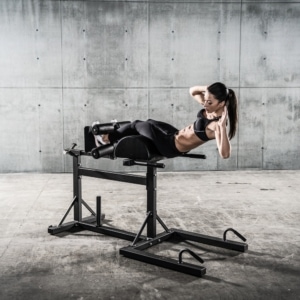
- A bench specifically designed for glute-ham raises, back extensions and assisted sit-ups. The pad can be adjusted lengthways to suit the user’s femur length.
- Hip Thrust
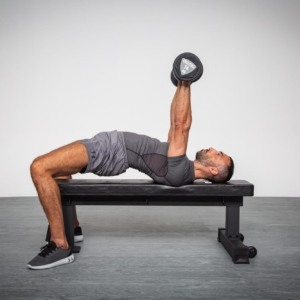
- A hip thrust exercise performed with the back resting against a bench or dedicated pad, with the barbell resting on the crease of the thigh. It selectively activates the gluteus maximus in maximum shortening.
- Jerk block
- Stackable metal or rubber blocks used for the jerk phase in Olympic weightlifting. They allow lifters to start from intermediate heights and reduce joint stress during high-volume training sessions.
- Landmine
- A floor-mounted attachment that secures one end of the barbell, allowing movement in three dimensions. Used for presses, rows and trunk rotations.
Comparison of Strength Sidea models
| Model | Type | Context of use | Dimensions |
|---|---|---|---|
| 9080 All-in-One Rack | Multifunctional rack | Home gym, personal training studio | Compact |
| Premium 9088 All-in-One Rack | Premium multifunctional rack | Commercial gym | Medium to large |
| All-in-One Machine 9087 | Integrated station with cables and plates | Studio PT, an advanced home gym | Medium |
| Cable Station Premium 9089A | Double crossover pulley | Gym fitness area | Wide |
| Powerlifting Rack 9045 | Rack dedicated to the three levels | Area Strength, CrossFit box | Medium |
| Flex Bench 9017 | Multi-angle adjustable bench | Universal | Compact |
| Belt Squat Machine 9124 | Squats with a weight belt | Gym, rehabilitation, advanced athletes | Medium |
| ADJ Metal Jerk Block 9115 | Adjustable weightlifting blocks | Weightlifting room | Modular |
Frequently Asked Questions about Strength Equipment
The most frequently asked questions from personal trainers, gym managers and home gym users are compiled in the FAQ section. These cover rack sizing, the differences between the various packages (Light, Full Optional, 360), choosing between a cable station and an all-in-one unit, and criteria for combining isotonic machines with free-weight racks.
Why choose Sidea for strength training equipment
Sidea has been manufacturing and distributing fitness equipment since 1999. The Gambettola site has over 4,000 m² of warehouse space with immediate availability of catalogue models, and the Gym Design service provides 3D renderings of the strength training area before purchase — useful when you need to present the project to a client or check that the rack will actually fit in your garage.
As the official distributor for StrongFirst and Luxiaojun in Italy, Sidea supports fitness trainers every step of the way, from choosing components right through to installation. Technical advice is provided directly, with no middlemen: you speak to people who know the equipment inside out and have seen hundreds of set-ups in commercial gyms, CrossFit boxes and home gyms.
Domande frequenti - Strength
-
The All-in-One Rack combines a squat rack, lat machine, low row and, often, a pull-up station into a single structure designed for free-weight barbell training plus cable accessories. The Cable Station, on the other hand, is dedicated solely to exercises using dual pulleys – typically crossover movements – with two independent weight stacks. If your training programme includes barbell squats and bench presses, choose the All-in-One; if you focus mainly on isolation exercises and cable work, the Cable Station is more efficient.
-
The Light Pack includes the basic frame with a lat machine and low row. The Full Optional adds accessories such as a land mine, multi-grip bar, dip station and handles. The 360 PACK is designed for multi-user commercial use and features side stations that allow 4–6 people to train simultaneously on the same frame, optimising the floor space in the weight room.
-
It is not essential, but it meets specific needs. The Belt Squat eliminates axial load on the spine, making it invaluable for athletes undergoing lumbar rehabilitation, for very high training volumes for the legs during the hypertrophy phase, and for older users or those with joint problems. In a commercial gym, it is an added bonus that sets the facility apart; in a home gym, it is only useful if you have a specific technical requirement.
-
The height depends on the model and the accessories chosen. As a general rule, you’ll need at least 240 cm for the basic version and 260–270 cm for configurations with a high pulley station and lat machine. Always check the technical specifications for the specific product before placing your order, or request technical advice, stating the exact height of your room.
-
The Flex Bench is a multi-angle adjustable bench designed for general use in gyms and personal training studios. For IPF powerlifting competitions, fixed benches with standardised cushion dimensions (width 29–32 cm, height 42–45 cm) are used. If your goal is competition, consider dedicated models; for training and preparation, the Flex Bench is perfectly suitable even for heavy loads.
-
Yes, Sidea is listed on MEPA with a dedicated price list for schools, public sports centres and local authorities. The machines in the Strength category comply with the technical requirements for intensive commercial use. The consultancy service also covers the technical documentation and installation aspects for public tenders.
-
The Cable Station Premium uses double pulleys with a typical ratio of 2:1 on the crossover stations, which means that the actual load on the handle is half that applied to the stack over a double stroke. The Bench Pro and Rack variants feature configurations with mixed ratios depending on the station. The technical data sheet for each model provides the specific details.
-
It depends on how they’re used. Machines with a stack of plates (such as the All-in-One Machine 9087) allow for quick weight changes without a spotter, making them ideal for personal training studios and home gyms. Racks that use bumper plates loaded onto pins are more versatile for strength training and Olympic weightlifting programmes, where micrometric increments and the ability to drop the barbell are required. Commercial gyms often stock both types.
-
Technically, yes – by resting your back against the long edge of a stable flat bench. However, dedicated hip thrust stations offer a wider, contoured pad, a barbell anchor that prevents slipping, and a height calibrated to the shoulder blade crease rather than a standard bench. If the hip thrust is a core part of your programme (glutes, sprinting, posterior chain injury prevention), the dedicated station reduces set-up time and improves form.
-
Dedicated bench compliant with safety standards, sturdy safety pins for training without a spotter, adjustable jerk blocks if you also do Olympic weightlifting, a plate rack for organising discs near the station, and a PU barbell pad for hip thrusts. If the rack is in a shared area, add a technical mat at least 20 mm thick beneath the barbell drop zone to protect the floor and equipment.
-
Sidea offers a range of instalment payment options to make it easier to purchase professional equipment. Please see the dedicated page: Sidea Payment Options.
-
If you work in the fitness or sports sector, register on the website as a Professional or as an ASD to gain access to the price list reserved for industry professionals. Pro registration allows you to view exclusive discounts and special terms across the entire Sidea catalogue.
-
Yes, Sidea is an authorised supplier on the MEPA (Public Administration Electronic Marketplace). Public bodies, schools, universities, local authorities and public sports facilities can purchase Sidea equipment via the Acquisti in Rete PA platform. For information on product codes and direct MEPA orders, please contact Sidea customer service.
-
Sidea guarantees the right to cancel within 14 days of delivery for all online purchases, in accordance with current legislation. Products must be returned undamaged and in their original packaging. For full details on returns, refunds and the warranty, please see the Terms and Conditions of Sale page.
-
Sidea has been designing and distributing professional fitness equipment since 1999: over 25 years’ experience serving gyms, sports coaches, CrossFit boxes, personal training studios and enthusiasts of advanced home fitness. Official distributor for StrongFirst and Luxiaojun, exhibiting at the FIBO international trade fair and technical sponsor of the Summit of Strength. Every product is developed with a focus on durability, functionality and suitability for real-world use. The Gym Design service offers bespoke design with 3D renderings. A warehouse covering over 4,000 m² in Gambettola (FC) ensures rapid order fulfilment, direct technical advice and a special price list for professionals and amateur sports clubs (ASD).

1013V Weightlifting balance board
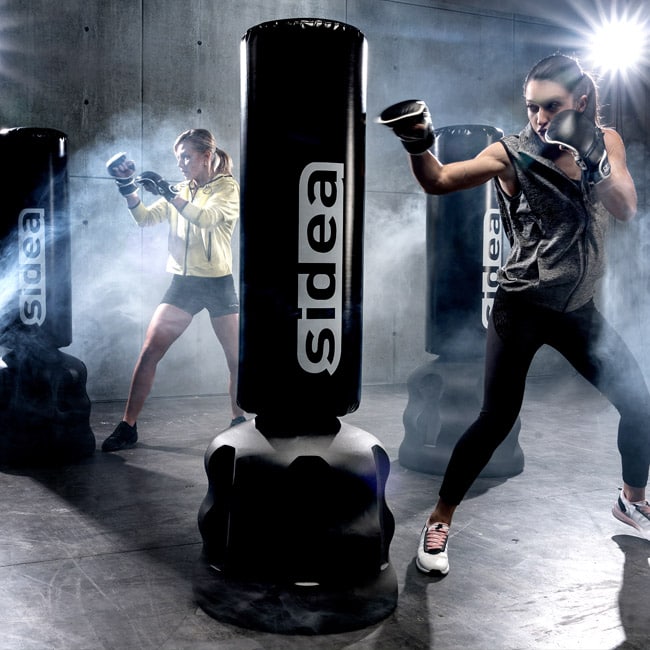
2095/1 Base+Bag Fitness Boxing Black
2097 Spare boxing fitness bag black
2108 Boxing Gloves 12OZ
2116 Training Pad striker pao
2909 Balance Pad
9023/1 Barbell Pad Hip Thrust
9023S Barbell Pad PU
9060 Wall Bar
9122 Hip Thrust Platform Bench
9122/1 Barbell Supports for Hip Thrust
9202P EcoGym Premium 2cm
9202S EcoGym Floor Straight Edge 2 cm
9203 EcoGym Garden 35mm