















-
×
 1710/1 Rope Protector
2 × 7,63€
1710/1 Rope Protector
2 × 7,63€ -
×
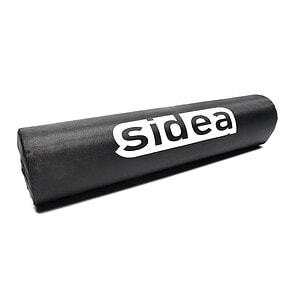 9023 Imbottitura Bilanciere
1 × 21,35€
9023 Imbottitura Bilanciere
1 × 21,35€
Department of Mechanics, Politecnico di Milano
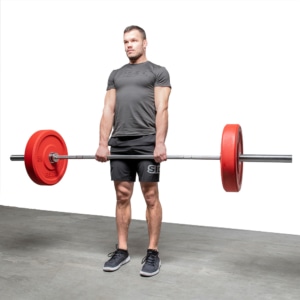
We asked the Department of Mechanics of the Politecnico di Milano, in the person of Prof. Francesco Braghin, to measure the stresses to which an Olympic barbell is subjected during the main exercises: bench press, deadlift, squat, snatch and sprint. The objective is extremely practical; to define simple and usable multiplication coefficients, however approximate, useful to the athlete in considering the stress of the discs loaded on the barbell with respect to the exercises performed.
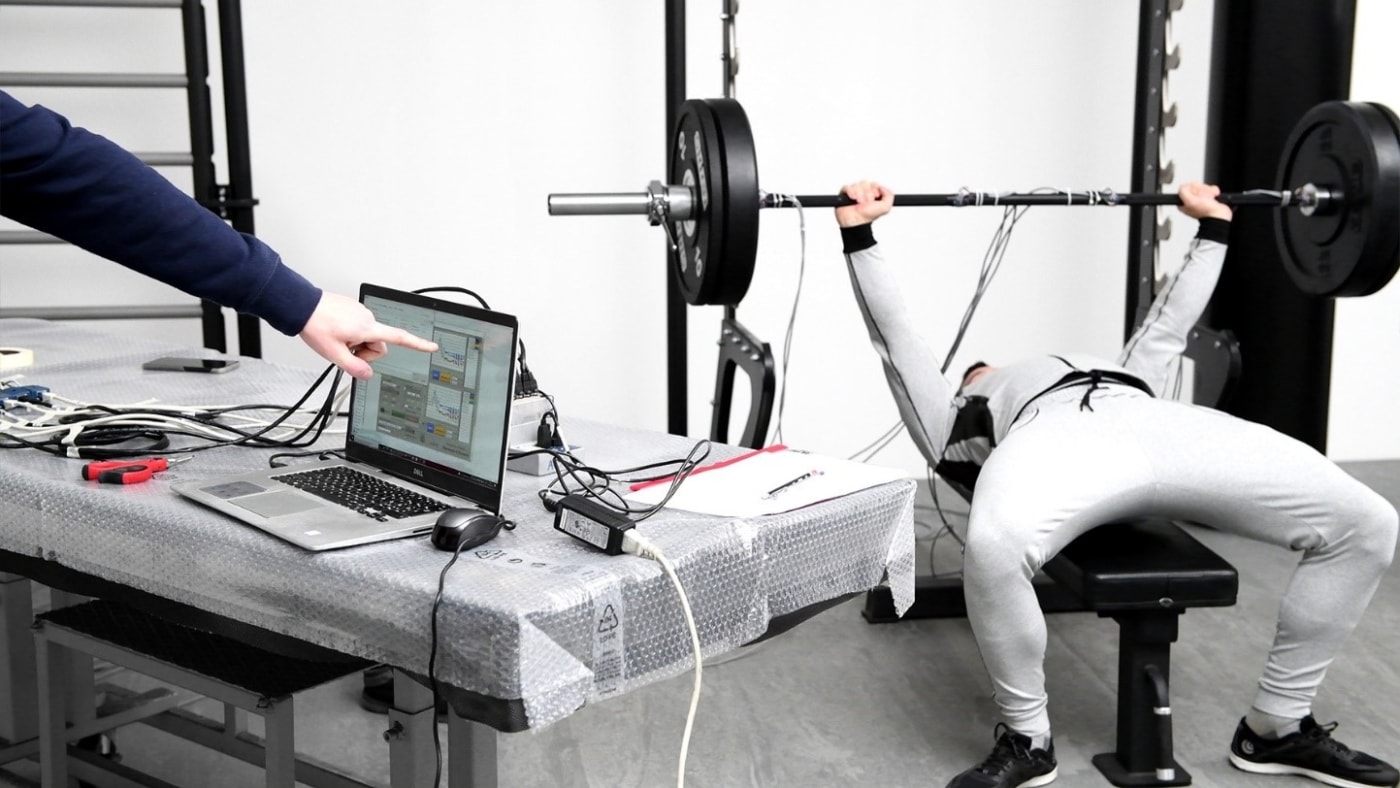
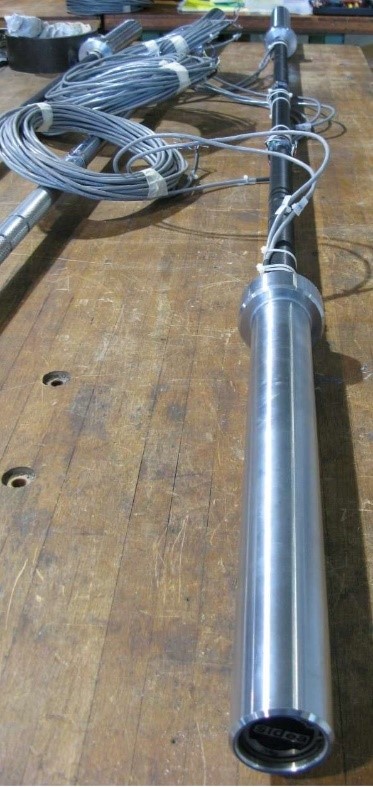
The activity consisted of the 'sensing' of three different models of Olympic balances; 9015/4, 9015/5, 9015/9, by technicians from the Department of Mechanics at the Politecnico di Milano who are qualified to bond strain gauge sensors.
Considering that the bending stresses on the rocker arm arise:
- by the weight forces at both ends, corresponding to the weight of the sleeves and weights;
- the forces exerted by the athlete's hands to lift the barbell
it was deemed necessary to instrument the bar in 4 different sections:
- two sections at the end of the rocker arm, i.e. the point as close as possible to the sleeve, compatible with the dimensions of the strain gauge and its electrical connections; these sections are therefore between the sleeve and the athlete's grip.
- two sections at the centre of the barbell and symmetrical to it, i.e. within the grip points of the athlete; for all instrumented barbells, the distance between these sections was taken to be 360 mm.
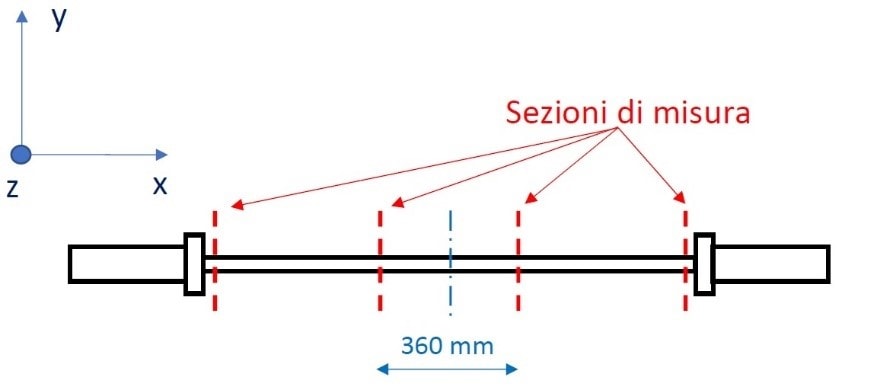
Being only interested in the bending of the rocker arm, it was possible to realise a strain measurement system using two complete strain gauge bridges for each section:
- No. 1 complete bridge along the horizontal plane (XZ);
- No. 1 complete bridge along the vertical plane (XY).
The use of complete strain gauge bridges, realised with two strain gauges orthogonal to each other placed on the two balance generators belonging to a diametrical plane, made it possible to make the measurement insensitive to axial action and temperature variations. A diagram of the positioning of the strain gauges on the measuring section is shown in the figure. Each blue patch in the figure contains the pair of orthogonal strain gauges described above.
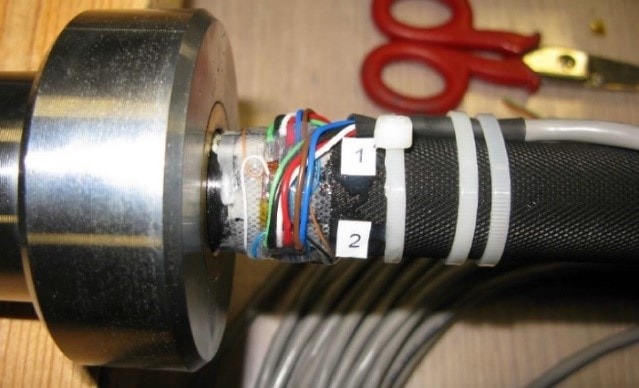
In total, therefore, eight 10-metre-long cables (to give the athlete sufficient comfort) corresponding to the eight measurement channels (bending along two directions for four measurement sections) branch off from each barbell.
For the zeroing of the strain gauge bridges, a simple test was performed: the rocker was placed in a vertical position (i.e. the position corresponding to zero bending moment on all four measuring sections), the output of the bridges (offset) was measured and this value was then subtracted from the measurements to be taken from there on.
Each test was acquired at a sampling frequency of 5 kHz, in order to measure not only the stresses due to the athlete's gestures, but also those of an impulsive nature due, for example, to the barbell falling to the ground.
Conclusions:
From the tests carried out on the three barbells, it was possible to see what was to be expected: the most dynamic exercises, with higher accelerations, resulted in the highest stress values. Stress was obviously highest and extended to all the sensors when the barbell fell, although in this case the maximum strain values differed greatly as a result of the way the barbell hit the ground.
With regard to the definition of the multiplication coefficients, the test showed:
- snatch and momentum x 3.0
- squat x 1.8
- bench press x 1.7
- stacco x 1.5
Therefore, taking the snatch and sprint exercise as an example, 100 kg of discs loaded on the Olympic barbell will exert a force weight corresponding to 300 kg.
Beware of falling from above! The multiplication coefficient was found to be x 3.25, but as we have said, it is subject to several variables.
Attention was also paid to the execution of the exercises. During the test, we stuck to 'standard', or as standard as possible, executions. Squats and deadlifts, but also bench presses, can be performed with high acceleration, in an explosive manner, and this inevitably raises the multiplication coefficients.
BARBELL WEIGHTLIFTING/POWERLIFTING
NEW


Weightlifting/Powerlifting barbells
199,00€ FEES and TAXES NOT INCLUDED
NEW
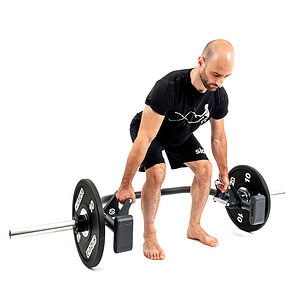
Weightlifting/Powerlifting barbells
297,38€ FEES and TAXES NOT INCLUDED
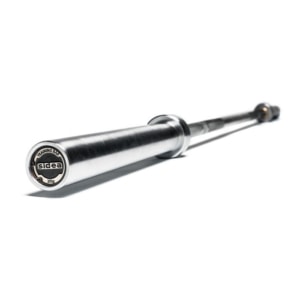
Weightlifting/Powerlifting barbells
199,01€ FEES and TAXES NOT INCLUDED
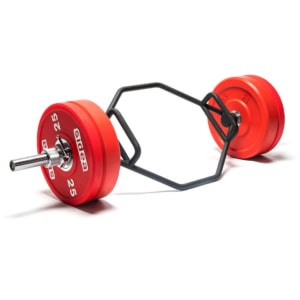
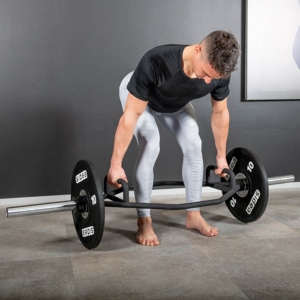
Weightlifting/Powerlifting barbells
274,50€ FEES and TAXES NOT INCLUDED
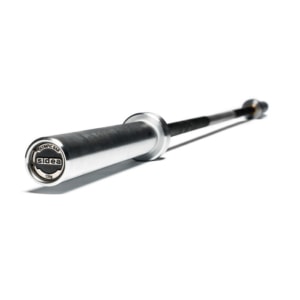
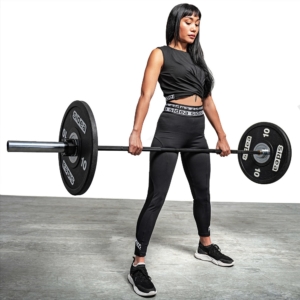
Weightlifting/Powerlifting barbells
298,90€ FEES and TAXES NOT INCLUDED
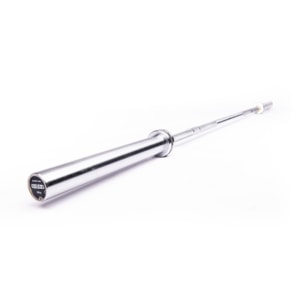
Weightlifting/Powerlifting barbells
398,03€ FEES and TAXES NOT INCLUDED
Weightlifting/Powerlifting barbells
178,43€ FEES and TAXES NOT INCLUDED
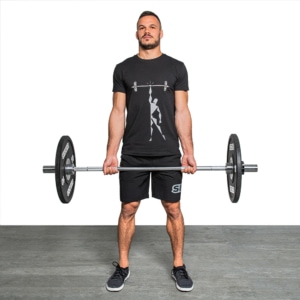
Weightlifting/Powerlifting barbells
147,93€ FEES and TAXES NOT INCLUDED
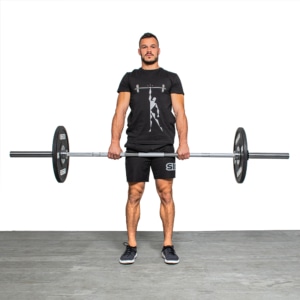
Weightlifting/Powerlifting barbells
198,25€ FEES and TAXES NOT INCLUDED
Weightlifting/Powerlifting barbells
97,60€ FEES and TAXES NOT INCLUDED

Weightlifting/Powerlifting barbells
60,24€ FEES and TAXES NOT INCLUDED
Weightlifting/Powerlifting barbells
398,03€ FEES and TAXES NOT INCLUDED
22,11€ FEES and TAXES NOT INCLUDED

22,11€ FEES and TAXES NOT INCLUDED
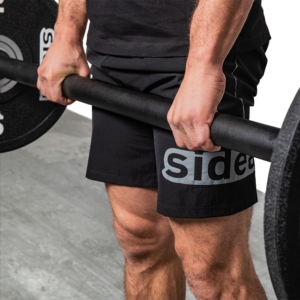
Weightlifting/Powerlifting barbells
148,69€ FEES and TAXES NOT INCLUDED


Weightlifting/Powerlifting barbells
248,58€ FEES and TAXES NOT INCLUDED


Weightlifting/Powerlifting barbells
189,10€ FEES and TAXES NOT INCLUDED

 Defibrillator AED
 Gift CardSidea
 Spare parts