



















Introduction: agility isn’t just about being quick on your feet
When it comes to agility, the temptation is always the same: to think that it all comes down to foot speed, explosive power or the ability to push harder.
In reality, in situational sports, elite agility is a far more complex quality. An athlete must accelerate, brake, absorb high forces, control their body in space, react to external stimuli and re-accelerate in a new direction in the shortest possible time.
For this reason, agility cannot be reduced to a series of exercises involving cones, step ladders or changes of footing. It is the result of the integration of strength, coordination, motor control, perceptual and decision-making abilities, and biomechanics.
True competitive advantage does not stem solely from the generation of force, but from the ability to manage energy and momentum: to absorb them, dissipate them when necessary, redirect them and transform them into useful motion.
This is where biomechanics becomes crucial.
Training agility means understanding at least two aspects of movement:
- the vertical component, linked to the stretching-shortening cycle and elastic recovery;
- the horizontal component, relating to braking, deceleration and changes of direction.
The stretch-shortening cycle: a spring, but not a passive one
The stretch-shortening cycle, or SSC, is one of the most important mechanisms in athletic performance.
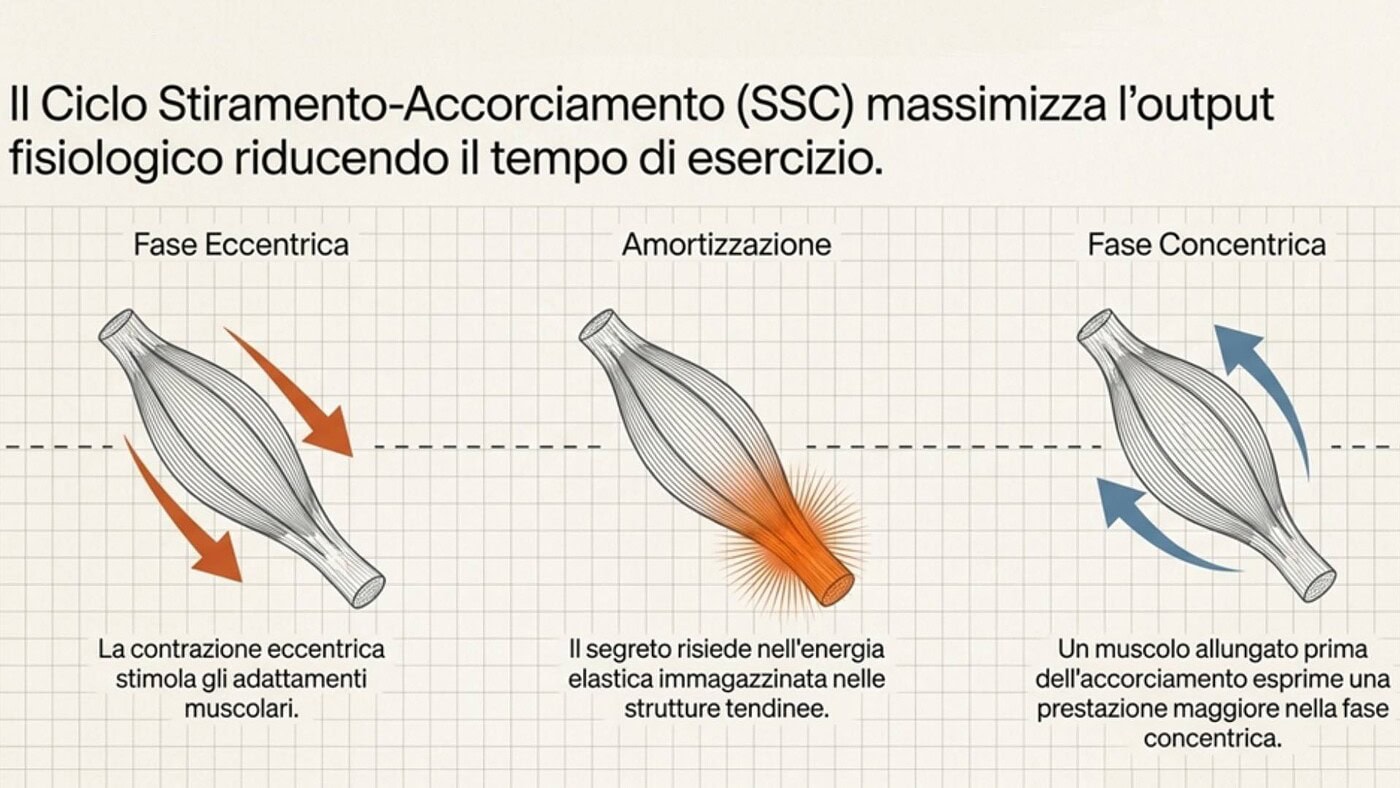
It occurs when an active eccentric contraction – in which the muscle lengthens whilst generating tension – is rapidly followed by a concentric contraction, in which the muscle shortens, producing movement.
A simple example is the counter-movement before a jump. Before jumping upwards, the athlete quickly lowers their body, loads the muscle-tendon system and then uses that preparatory phase to generate a more effective push-off.
It is often said that the body works “like a spring”. This analogy is useful, but it needs clarifying: the musculo-tendinous system is not a passive spring. It is an active-passive system, in which elastic energy, eccentric muscle work, neuromuscular coordination and reflex contributions all contribute to the final performance.
The eccentric phase is therefore not simply a stretch. It is an active, controlled phase in which the athlete must be able to absorb force whilst maintaining an efficient body structure. The transition phase, or cushioning phase, must be sufficiently rapid to prevent excessive energy loss. The final concentric phase releases part of the stored energy and adds the force actively generated by the neuromuscular system.
The key point is that it is not enough simply to be strong. You have to be able to apply force at the right moment.
If the transition between the eccentric and concentric phases is too slow, some of the energy is lost. If, on the other hand, the athlete manages to maintain short contact times, good joint control and adequate functional stiffness, the system becomes more efficient.
Tendons, stiffness and elasticity: why “supple” doesn’t necessarily mean better
One of the most sensitive issues in the biomechanics of the SSC concerns the role of tendons.
In everyday language, one might think that a more “flexible” structure is always more effective because it allows for greater pre-stretching. In reality, however, this concept needs to be approached with caution.
In fast movements, particularly when contact times are brief, good tendon stiffness is generally a positive factor. A tendon that is too flexible can increase energy loss and reduce the ability to transfer force to the ground quickly.
This does not mean that the system must be rigid in an absolute sense. The more accurate concept is that of controlled elasticity: the musculo-tendinous system must deform just enough to store energy, but it must also be rigid enough to release it quickly and effectively.
Performance in the SSC therefore depends on a balance: not pure rigidity, not pure compliance, but the capacity for reversible elastic deformation, coordinated with muscular action and the timing of the sporting movement.
In the counter-movement jump, this balance allows for better utilisation of the pre-load. When changing direction, the problem becomes even more complex, because the force must not only be directed upwards, but often needs to be directed horizontally as well.
The difference between an athlete who is simply strong and one who is truly agile lies precisely here: in the ability to direct one’s strength.
Changing direction is a physical challenge, not just a muscular one
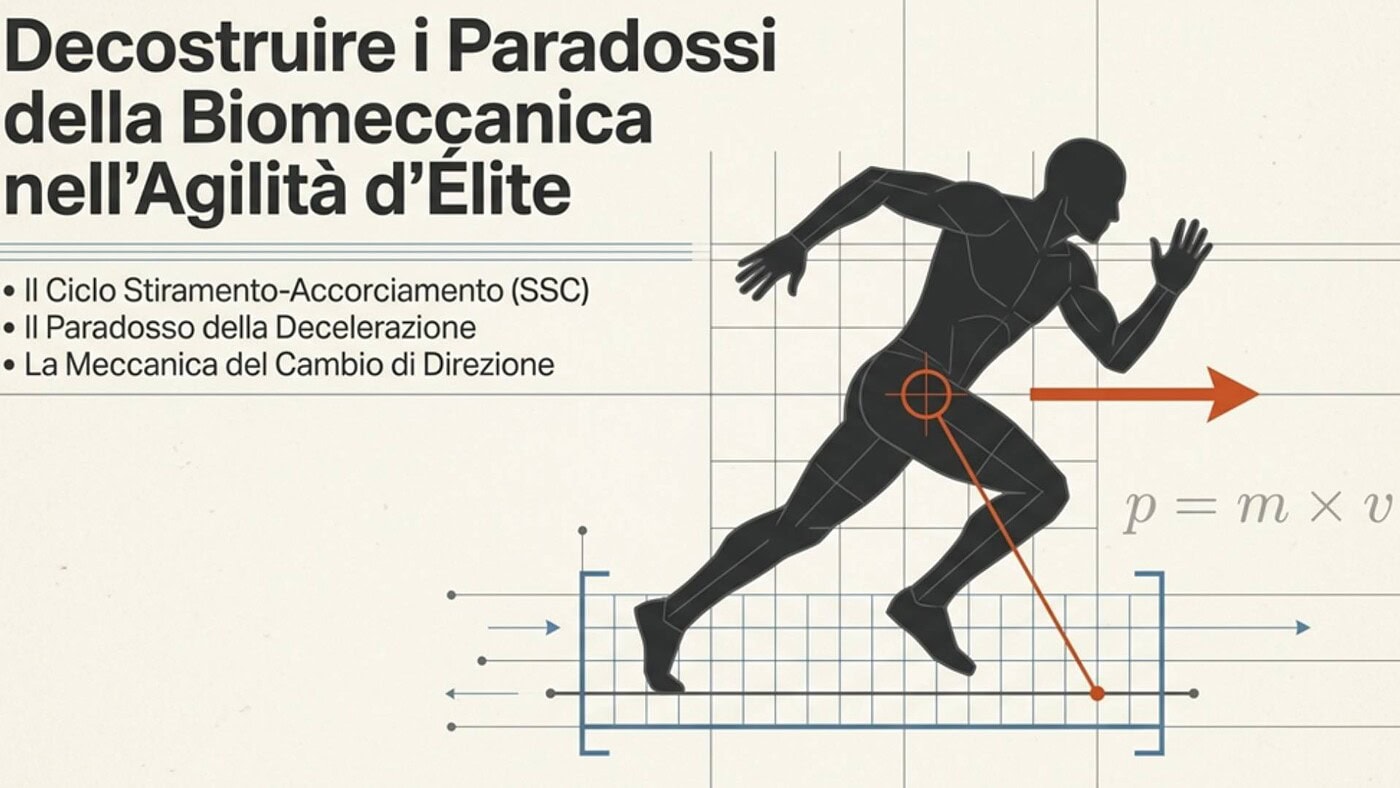
Every moving athlete possesses momentum. Momentum is expressed by the formula:
p = m × v
where m is the athlete’s mass and v It’s the speed.
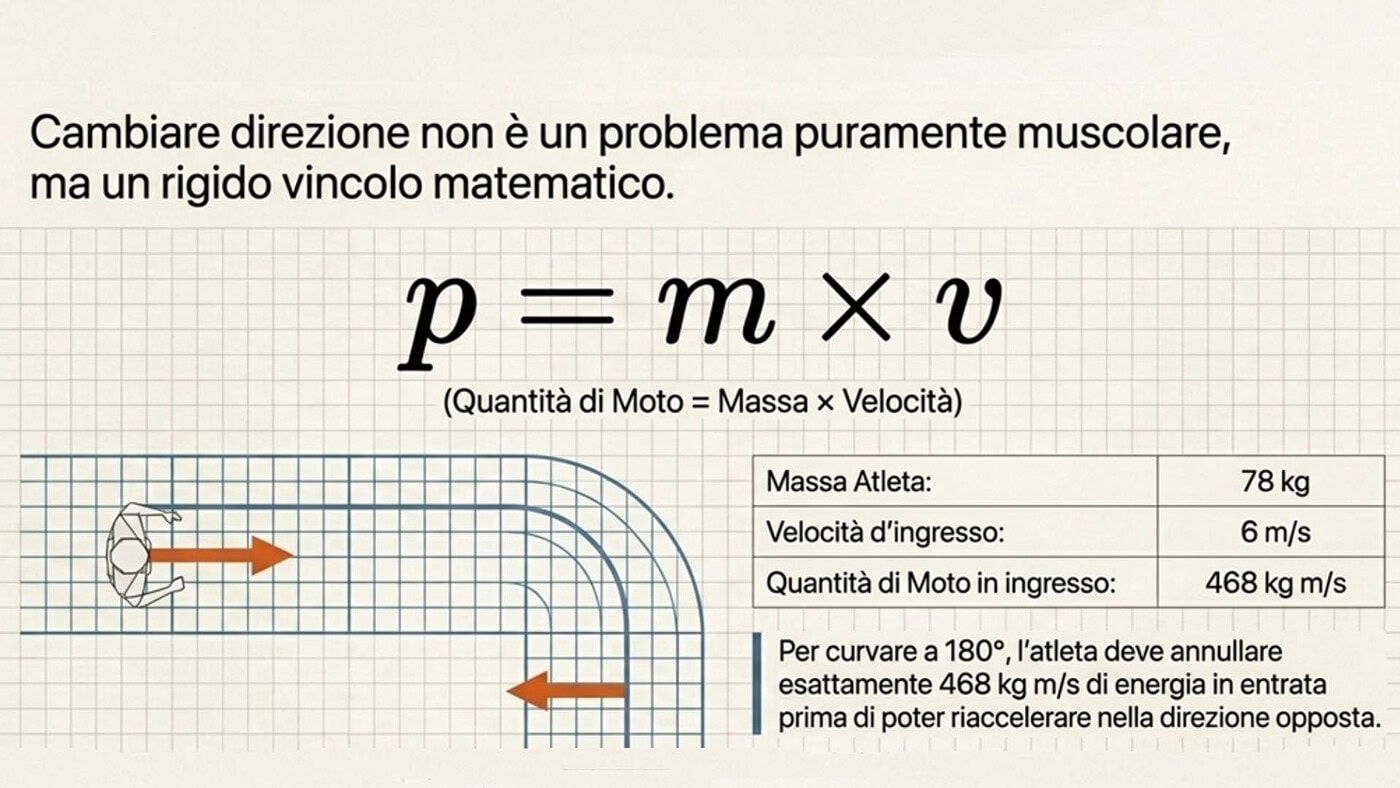
This value is not just “how much movement” the athlete has: it is a vector. This means that it has a magnitude, but also a direction. When changing direction, the direction is crucial.
When an athlete brakes or turns, they must change their momentum. To do this, they must generate an impulse, that is, a force applied over a certain period of time:
F × Δt = Δp
The greater the change in momentum required, the greater the impulse needed.
Another quantity also comes into play here: kinetic energy, which is expressed as:
Ec = ½mv²
This distinction is important. Momentum increases linearly with speed. Kinetic energy, on the other hand, increases with the square of the speed. This means that increasing the entry speed makes braking much more difficult.
A heavier and faster athlete must not simply “push harder”. They must also brake, dissipate and redirect greater forces, often within a very short space of time.
For this reason, deceleration is a fundamental athletic ability.
Deceleration: the often-overlooked aspect of performance
A fast athlete is not automatically an agile athlete.
The greater the speed at the start of a change of direction, the greater the momentum that needs to be altered and the greater the kinetic energy that needs to be managed. Consequently, the athlete must be able to apply high braking forces that are correctly directed and distributed within a timeframe compatible with the sporting movement.
This is not a true physical paradox, but a direct mechanical consequence: to change direction quickly, you first need to know how to slow down in the right way.
This is particularly evident during 180° changes of direction, where the athlete must drastically reduce or come to a complete stop in the original direction before accelerating again in the opposite direction.
Concentric strength is needed to accelerate. But first of all, you need great eccentric strength to slow down.
In the biomechanics of deceleration, it is useful to distinguish between different components of the ground reaction force. The anteroposterior component contributes primarily to braking and subsequent re-acceleration. The mediolateral component, on the other hand, plays a key role in lateral cuts and changes of direction. In an effective change of direction, the athlete must be able to modulate both: braking in the direction from which they are coming and generating force in the direction they wish to go.
Another important factor is ground contact time. Shorter ground contact times can lead to faster performance, but they also require the ability to generate high forces within short time frames. This is where part of the trade-off between performance and safety comes into play: the faster and more aggressive the movement, the greater the mechanical demands placed on muscles, tendons and joints.
That is why athletic training should not be limited to sprints, jumps and acceleration drills. It must also include specific exercises for deceleration: progressive braking, controlled landings, eccentric exercises, exercises involving inertial overload, changes of direction at different angles, and drills that gradually increase the initial speed.
In other words: the athlete must learn to brake hard, but without losing control.
The role of the PFC: the penultimate support sets up the change of direction
When changing direction, attention is often focused on the last foot to touch the ground – that is, the foot that “plants” itself on the ground to slow down and set off again. However, the phase immediately preceding this is just as important.
PFC, which stands for ‘penultimate foot contact’, refers to the penultimate foot contact before a change of direction. It is a key phase because it prepares the body for deceleration, helps to lower the centre of mass and allows for better load distribution before the final foot strike.
An athlete who arrives too high, too far forward or too fast at the final foot strike will be forced to manage an enormous amount of force in a very short space of time. Conversely, effective PFC allows deceleration to begin before the final foot strike, making the change of direction smoother, quicker and potentially safer.
In practical terms, this means that you should not only watch “the foot that changes direction”, but also the previous step. Often, the quality of the cut is determined before the foot makes final contact with the ground.
Training the PFC involves teaching the athlete to prepare their body: lowering their centre of mass, shortening or adjusting their stride, aligning their torso, and creating the conditions to generate effective horizontal force.
Why a stopwatch can be misleading
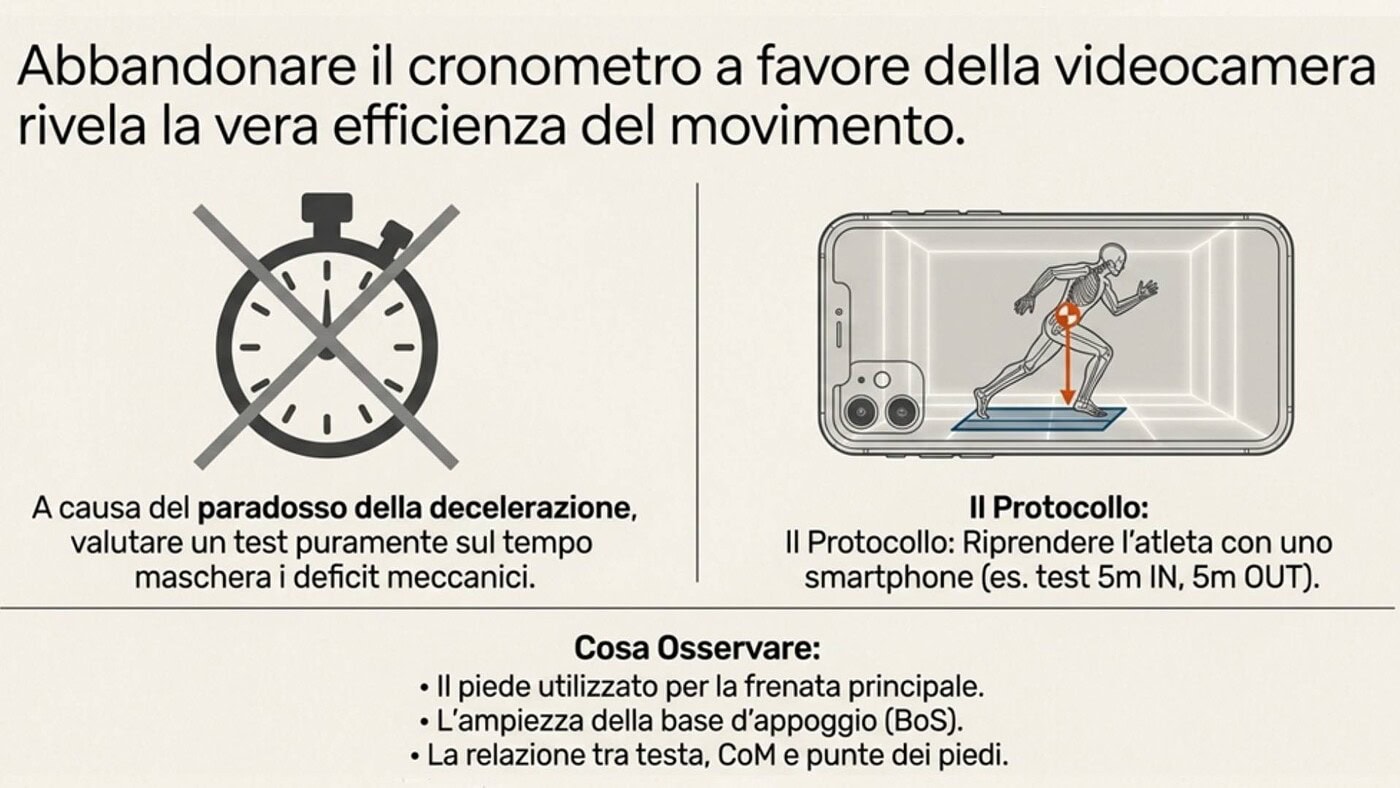
Many traditional agility tests are based solely on the final time. The problem is that the stopwatch measures the result, but does not explain how that result was achieved.
A lighter or slower athlete may achieve a good time not necessarily because they have superior technique, but because they have less momentum to alter and less kinetic energy to manage.
Similarly, a very fast athlete may be penalised in a change-of-direction test if they enter the turn at high speed but lack sufficient braking ability to control it.
For this reason, the concept of Change of Direction Deficit, or COD deficit, has become widespread in the literature. The idea is simple: to separate, as far as possible, the linear sprint component from the actual ability to change direction. The total time taken for a test such as the 505 can be influenced by linear speed; the COD deficit, on the other hand, attempts to better isolate the specific cost of changing direction.
This does not mean that the stopwatch is useless. It means that it is not enough on its own.
Nowadays, even a simple video camera or a smartphone can provide valuable information. Filming a test allows you to observe:
- which foot is used for the main braking;
- how the PFC – that is, the penultimate plantar contact – is managed;
- the width of the base;
- the position of the torso and head;
- the relationship between the centre of mass and the point of support;
- the number of corrective steps before re-acceleration;
- the time spent in contact with the ground;
- the actual direction of the force applied to the ground.
Time tells us “how much”. The video helps us understand “how”.
Centre of mass and base of support: the key to changing direction
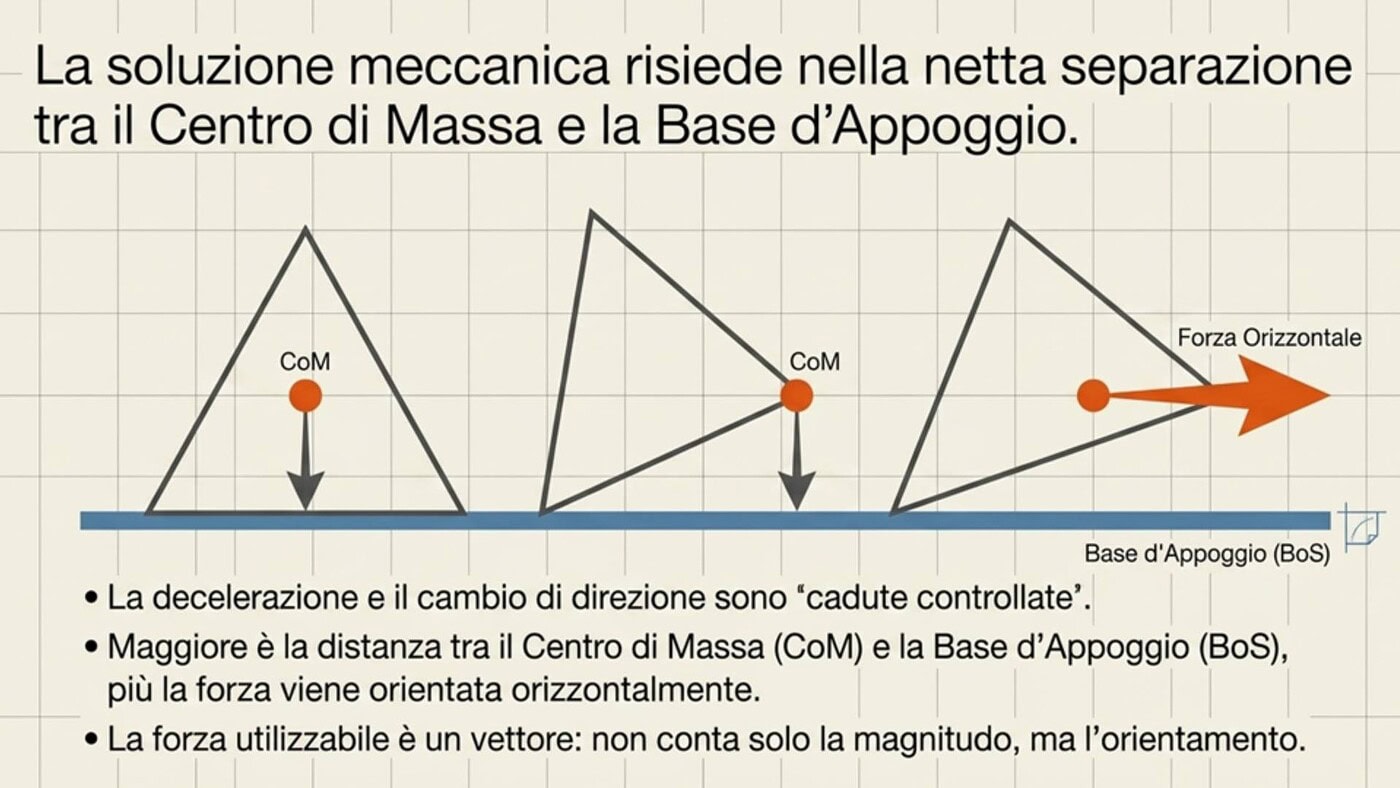
The mechanical principle behind a change of direction lies in the relationship between the centre of mass and the base of support.
Put simply, the centre of mass is the point at which the body’s mass is concentrated. The base of support is the area through which the athlete interacts with the ground.
In an effective change of direction, the athlete creates a strategic separation between their centre of mass and their supporting foot. This separation allows them to better direct the reaction force from the ground, generating a horizontal component that is useful for braking, changing direction or accelerating again.
If the body remains too upright, the force generated tends to be less effective at altering the trajectory. If, on the other hand, the athlete manages to lower their centre of mass, tilt their body in a controlled manner and position their foot correctly, the force can be directed in the desired direction.
A change of direction is therefore not simply a series of quick steps. It is a controlled fall.
The athlete must create an imbalance, but without losing functional stability. They must move out of the neutral position, whilst retaining the ability to apply force at the right point and at the right moment.
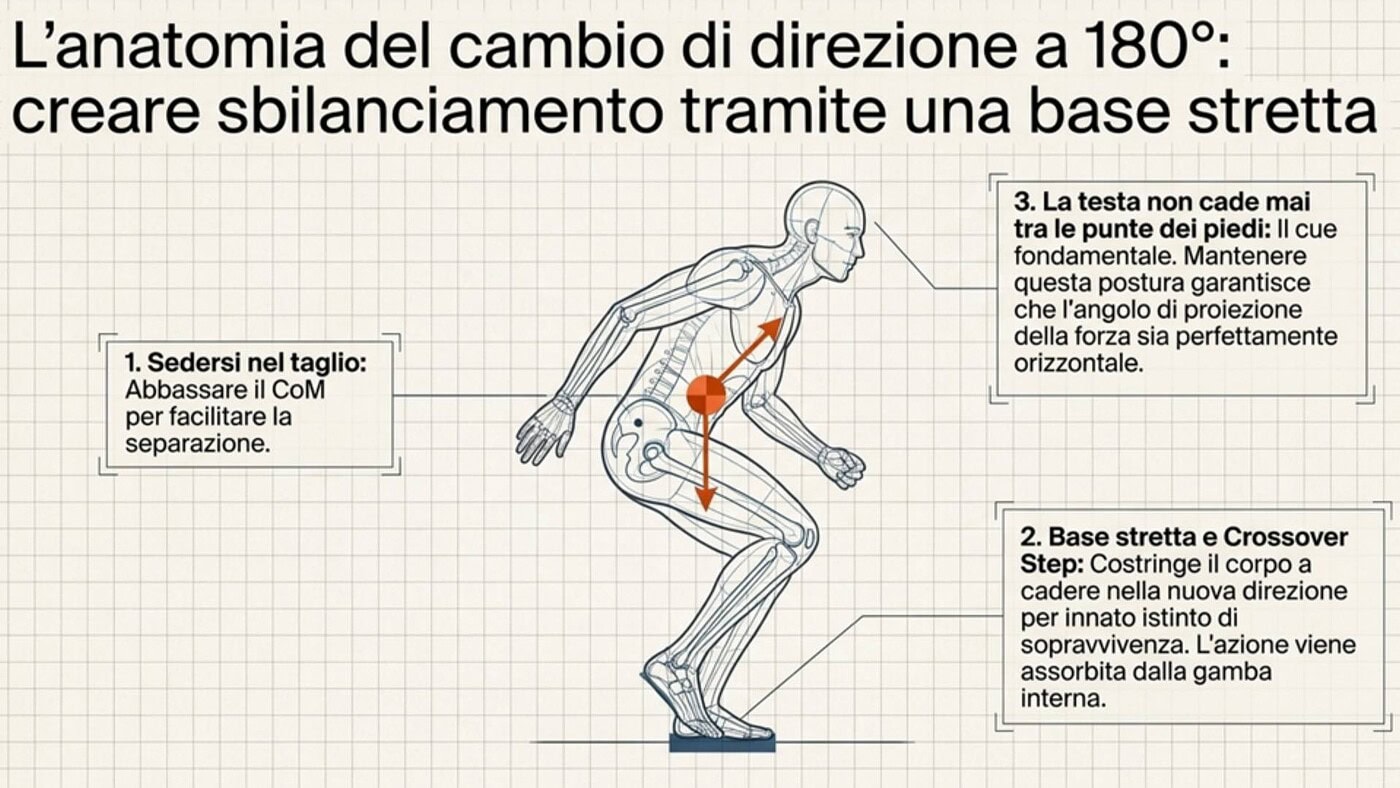
A 180° turn: put the brakes on before setting off again
In 180° turns, the main aim is to reduce or eliminate the momentum in the original direction and generate a new impulse in the opposite direction.
Effective technique often requires a lowering of the centre of mass, good eccentric strength, a controlled base of support and a body orientation that facilitates horizontal propulsion in the new direction.
A common mistake is the so-called reaching: the athlete tries to find the line, the cone or the marker by extending their outside leg too far.
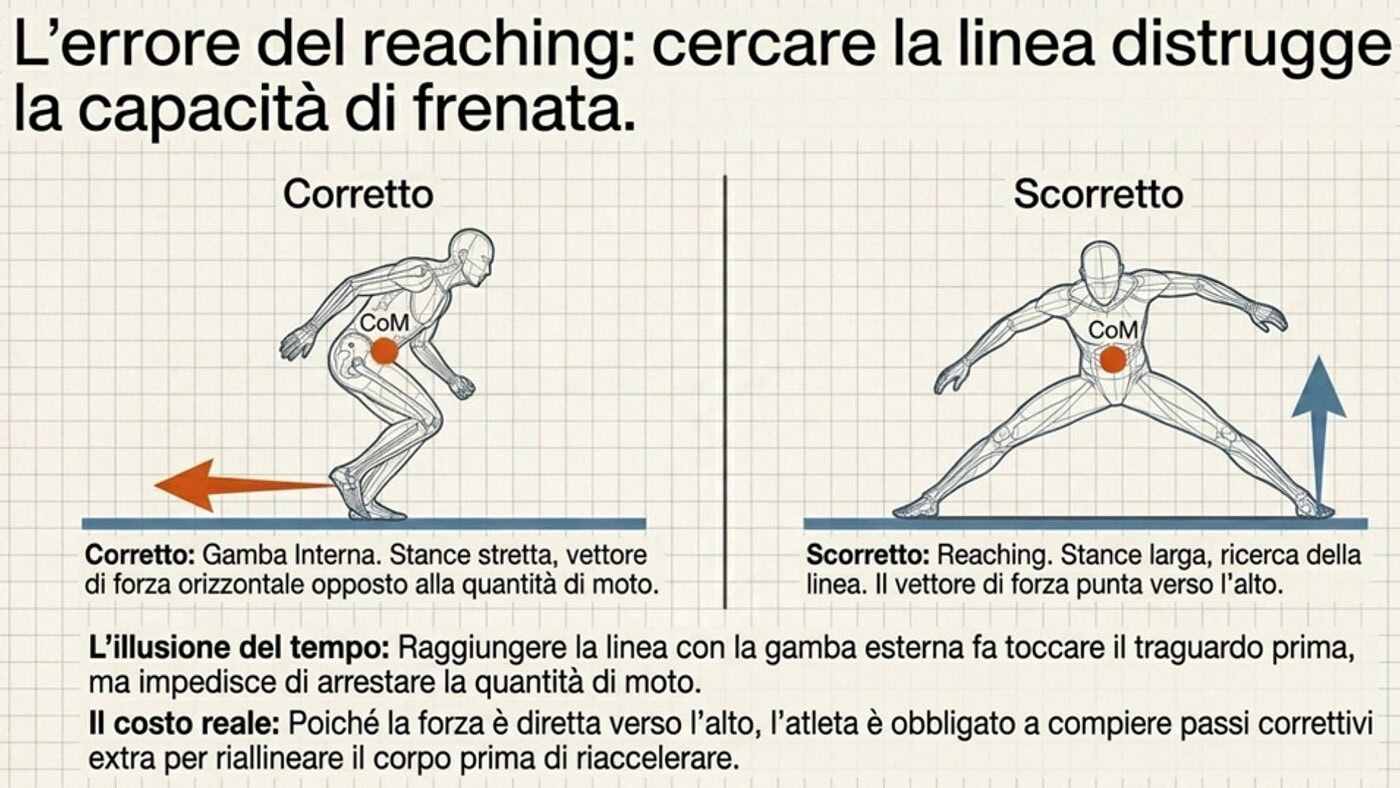
At first glance, this may seem like a beneficial strategy, as it allows you to reach your target sooner. In reality, however, it often reduces braking efficiency.
The problem is not simply that the force “points upwards”. The problem is more complex: a foot placement that is too far from the body can increase ground contact time, impair the ability to generate horizontal braking force, increase joint moments and force the athlete to make corrective steps before re-accelerating.
When changing direction, reaching the line first does not necessarily mean coming out of the line better.
True quality is evident in the ability to brake, turn and accelerate again with as few adjustments as possible.
60° and 90° cuts: ‘plant-and-cut’, feints and risks to manage
With 60° and 90° cuts, the dynamics are different from those of a 180° turn.
Here, the athlete does not need to change direction completely, but rather adjust their trajectory whilst maintaining some of their speed. In this case, the outside foot often plays a crucial role in the ‘plant-and-cut’ or ‘side-step cut’ phase.
In some sports, an athlete may use a feint, a preparatory step or a deceptive movement to draw the defender out of position and create a new path. The biomechanical principle involves creating an effective separation between the centre of mass and the base of support, converting the initial velocity into horizontal momentum in the new direction.
This strategy can be very effective in terms of performance, but it needs to be practised carefully.
A marked separation between the centre of mass and the supporting foot, when combined with poor knee control, dynamic valgus, uncontrolled rotations or poor trunk positioning, can increase the loads on the knee and contribute to situations of increased risk to the anterior cruciate ligament.
This concept is known in recent literature as the ‘performance-injury conflict’ or ‘performance-injury trade-off’: certain biomechanical strategies that promote rapid changes of direction may, if not controlled, also increase the loads on the joints.
It is not enough simply to change direction more quickly. We must do so in a sustainable way.
The ideal technique is not one that always minimises every load, because in sport the athlete must still generate force and cope with high-intensity situations. The aim is to strike a balance: to maximise performance without unnecessarily exposing the musculoskeletal system to avoidable stress.
How to really train your agility
Training agility in a modern way means integrating physiology, physical training, technique and the sporting context.
From a physiological perspective, the aim is to develop eccentric strength, functional stiffness and the ability to utilise the stretch-shortening cycle within timeframes compatible with the sport.
From a physical point of view, it is important to understand that mass, speed, momentum and kinetic energy influence every change of direction. A fast athlete must not only accelerate rapidly: they must also decelerate rapidly.
From a technical perspective, it is essential to develop effective biomechanics: a lower centre of mass when required, well-aligned foot placement, a controlled upper body, a reduction in corrective movements, and the ability to generate horizontal forces for braking and re-acceleration.
In practical terms, training must move from general exercises to targeted progression.
Here are some operational guidelines.
-
Training eccentric strength
Include exercises such as split squats, controlled lunges, step-downs, eccentric squats, Nordic hamstring exercises, calf exercises and exercises using inertial overload. The aim is not just to “build strength”, but to learn how to absorb force.
-
Using flywheel training for eccentric overload
Exercises using a flywheel, or flywheel training, can be particularly useful as they allow the eccentric phase to be emphasised. Unlike many traditional exercises, the flywheel system can generate a high braking demand during the return phase, stimulating the athlete’s ability to absorb and control force.
This makes it useful when preparing for changes of direction, where the ability to decelerate quickly is crucial.
-
Progressive deceleration training
Start with linear braking at low speeds, then gradually increase the entry speed, stopping distance, exit angle and complexity of the task.
Progression must take into account both the anteroposterior component – that is, deceleration and re-acceleration – and the mediolateral component – that is, the control of lateral forces during changes of direction.
-
Using vertical and horizontal plyometrics
Vertical jumps are useful, but to improve changes of direction, you also need more specific exercises in the horizontal plane: bounding, broad jumps, lateral bounds, side hops and controlled single-leg landings.
Horizontal and lateral plyometrics help athletes to better manage the forces that actually come into play during changes of direction on the pitch.
-
Working from different angles
Turns of 45°, 60°, 90° and 180° require different strategies. It makes no sense to practise them all in the same way.
A 60° turn requires a different approach to speed control than a 180° turn. The contact points, the role of the PFC, the direction of the force and the relationship between braking and re-acceleration all change.
-
Assess the mechanics, not just the time
Use the video to analyse foot placement, trunk position, knee position, the relationship between the centre of mass and the base of support, the number of corrective steps, ground contact time and the quality of re-acceleration.
Technology can be simple: even a smartphone, if used wisely, can provide useful information. What makes the difference is the coach’s ability to know what to look out for.
-
Integrating perception and decision-making
Sporting agility is not just about pre-planned changes of direction. During a match, the athlete must react to the ball, opponents, teammates and space.
For this reason, once the technical phase is complete, reactive and situational exercises are needed. The aim is not just to change direction effectively, but to change direction effectively at the right moment.
-
Managing joint risk
When performing high-intensity cuts, particularly lateral ones, it is essential to develop control of the knee, core position and the quality of the foot strike.
Performance must not be viewed in isolation from injury prevention. The coach must understand the performance-injury conflict and design training programmes that increase the athlete’s ability to tolerate high loads without compromising their biomechanical quality.
From speed to the quality of movement
Elite agility isn’t just about going fast.
It’s about knowing how to slow down when necessary, maintaining control, positioning your body and accelerating again in the right direction.
A truly agile athlete is not the one who moves their feet the fastest of all, but the one who manages to convert strength, energy and momentum into useful movement with as little waste as possible.
For this reason, athletic training must go beyond the idea of simply “speed work” and focus on what is actually happening in the body: tendons that store and release energy, muscles that act as brakes, points of contact that direct force, the centre of mass that separates from the base of support, and vectors that determine the trajectory.
Biomechanics is not some theory far removed from the practical world. It is what enables us to understand why an athlete brakes better, changes direction more effectively and accelerates with greater power.
Conclusion
The new paradigm of agility integrates physiology, physics and practice.
Physiology explains how the musculo-tendinous system produces, absorbs and returns energy.
Physics explains why mass, speed, momentum and kinetic energy make deceleration so challenging.
Biomechanics explains how the centre of mass, base of support, PFC, ground contact time and the direction of ground reaction forces influence the quality of a change of direction.
Practical experience in the field translates these principles into exercises, progression and concrete assessments.
Training agility therefore means training the ability to control movement, not just to produce it.
For strength and conditioning coaches, coaches and performance centres, this approach paves the way for a more precise approach: fewer generic tests, more technical observation; less reliance on the stopwatch as the sole judge, more movement analysis; fewer random exercises, more progressive drills based on the actual mechanics of the sport.
Because when changing direction – as with any high-level athletic movement – it is not just the person who pushes hardest who wins.
The winner is whoever knows how to use force most effectively.
Spare parts
202,82€ VAT included, shipping calculated at checkout
NEWS'
Premium All-in-One Wall Rack
5.830,00€ VAT included, shipping calculated at checkout
NEWS'
Premium All-in-One Wall Rack
3.780,00€ VAT included, shipping calculated at checkout

Spare parts
170,56€ VAT included, shipping calculated at checkout
Spare parts
170,56€ VAT included, shipping calculated at checkout
-30%


Strong fitness training
High Performance Component
58,56€
Questo prodotto ha più varianti. Le opzioni possono essere scelte nella pagina del prodotto


Spare parts
24,43€ VAT included, shipping calculated at checkout
Bibliography
- Komi, P. V. (2000). Stretch-shortening cycle: a powerful model for studying normal and fatigued muscle. Journal of Biomechanics, 33(10), 1197–1206. DOI: 10.1016/S0021-9290(00)00064-6.
- Kubo, K., Kanehisa, H., Kawakami, Y., & Fukunaga, T. (1999). The influence of the elastic properties of tendon structures on jump performance in humans. Journal of Applied Physiology, 87(6), 2090–2096. DOI: 10.1152/jappl.1999.87.6.2090.
- Sheppard, J. M., & Young, W. B. (2006). Agility literature review: classifications, training and testing. Journal of Sports Sciences, 24(9), 919–932. DOI: 10.1080/02640410500457109.
- Nimphius, S., Callaghan, S. J., Bezodis, N. E., & Lockie, R. G. (2018). Change of direction and agility tests: challenging our current measures of performance. Strength and Conditioning Journal, 40(1), 26–38. DOI: 10.1519/SSC.0000000000000309.
- Dos’Santos, T., Thomas, C., Jones, P. A., & Comfort, P. (2017). Mechanical determinants of faster change-of-direction speed performance in male athletes. Journal of Strength and Conditioning Research, 31(3), 696–705.
- Dos’Santos, T., Thomas, C., Comfort, P., & Jones, P. A. (2018). The effect of angle and velocity on the biomechanics of changes of direction: an angle-velocity trade-off. Sports Medicine, 48(10), 2235–2253.
- Dos’Santos, T., Thomas, C., Comfort, P., & Jones, P. A. (2019). The role of the penultimate foot contact during a change of direction: implications for performance and the risk of injury. Strength and Conditioning Journal, 41(1), 87–104.
- Dos’Santos, T., Thomas, C., McBurnie, A., Comfort, P., & Jones, P. A. (2021). Biomechanical determinants of performance and injury risk during cutting: a conflict between performance and injury? Sports Medicine, 51(9), 1983–1998.
- McBurnie, A. J., Harper, D. J., Jones, P. A., & Dos’Santos, T. (2022). Deceleration training in team sports: another potential “vaccine” against sports-related injuries? Sports Medicine, 52(1), 1–12. DOI: 10.1007/s40279-021-01583-x.
- Donelon, T. A., Dos’Santos, T., Pitchers, G., Brown, M., & Jones, P. A. (2020). Biomechanical determinants of knee joint loads associated with increased anterior cruciate ligament loading during cutting manoeuvres: a systematic review and technical framework. Sports Medicine – Open, 6, Article 53. DOI: 10.1186/s40798-020-00276-5.
 Defibrillator AED
 Gift CardSidea
 Spare parts