The 10% discount has been activated using the code HALLOWEEN10.
«9088K1 All-in-One Rack Premium LIGHT PACK» has been added to your basket. View cartDiscount of 10% active on your order.
There’s no such thing as the best rack: there’s just the one that’s best suited to your space and your training style
Choosing a rack isn’t simply a matter of deciding which one to buy.
It means understanding cHow it will be used, how much space we actually have available, whether we can fix it to the wall or the floor, how many users will be using it and, above all, which exercises we want to focus on at that station.
Two simple barbell racks and a professional-grade rack with a capacity of over 500 kg can both be used for squats. Yet they serve completely different purposes.
That is precisely the starting point.
Before you even start comparing prices, sizes or accessories, it’s worth asking yourself four questions:
How much space do I actually have available?
Can I fix the structure to the wall or to the floor?
Will the rack be used by just one person or by several users throughout the day?
Do I mainly need squats and bench presses, or do I want to do lots of different exercises at the same station?
Once you’ve answered these questions, choosing the right rack becomes much easier.
Limited space and a need to free up room: 9045/1 Olympic Bar Support Pro
When the training area has to share space with other functions of the room, a permanent structure can become impractical.
In this case, the simplest solution is 9045/1 Olympic Bar Support Pro.
These are two freestanding barbell stands, fitted with wheels and specifically designed to be easily moved, transported or stored away after use. SIDEA recommends them for squats and a wide range of strength training exercises, and they can be used in combination with a bench and Safety Spotters. Sidea Fitness
The main advantage, therefore, is not just its compact size.
It is the freedom to reconfigure the space.
Whether in a home gym set up in a multi-purpose room, a small personal trainer’s studio, or an athletic training facility where equipment is frequently moved, this feature can be crucial.
When to choose it
It is particularly suitable when:
space cannot be occupied permanently;
the rack must be easy to move;
The training programme is mainly based on barbell exercises and bench presses;
A large modular structure is not necessary.
When to choose something else
If, on the other hand, you’re looking for a permanent workstation that’s more structured and designed to accommodate a wide range of accessories, it makes sense to upgrade to a higher-spec solution.
When squats and bench presses are at the heart of your training: 9045 Powerlifting Rack
Greater versatility does not always mean a better choice.
If the main aim is to train squats seriously and bench press, a dedicated machine may be more efficient than a multifunction machine.
The 9045 The Powerlifting Rack was created precisely with this philosophy in mind.
This is a professional training station designed for squats and bench presses, developed to powerlifting standards and fitted with a Safety Spotter, dedicated adjustment mechanisms and barbell supports with rollers. It can also be integrated with the Flat Bench 9020 using a specialised anchoring system. Sidea Fitness
His reasoning is very clear:
He doesn’t try to do everything, but rather to build an extremely effective set-up around the big lifts.
For a powerlifter, whether at a specialist strength gym or a home gym designed primarily for squats and bench presses, this specialisation is an advantage.
And it can work even in less conventional contexts.
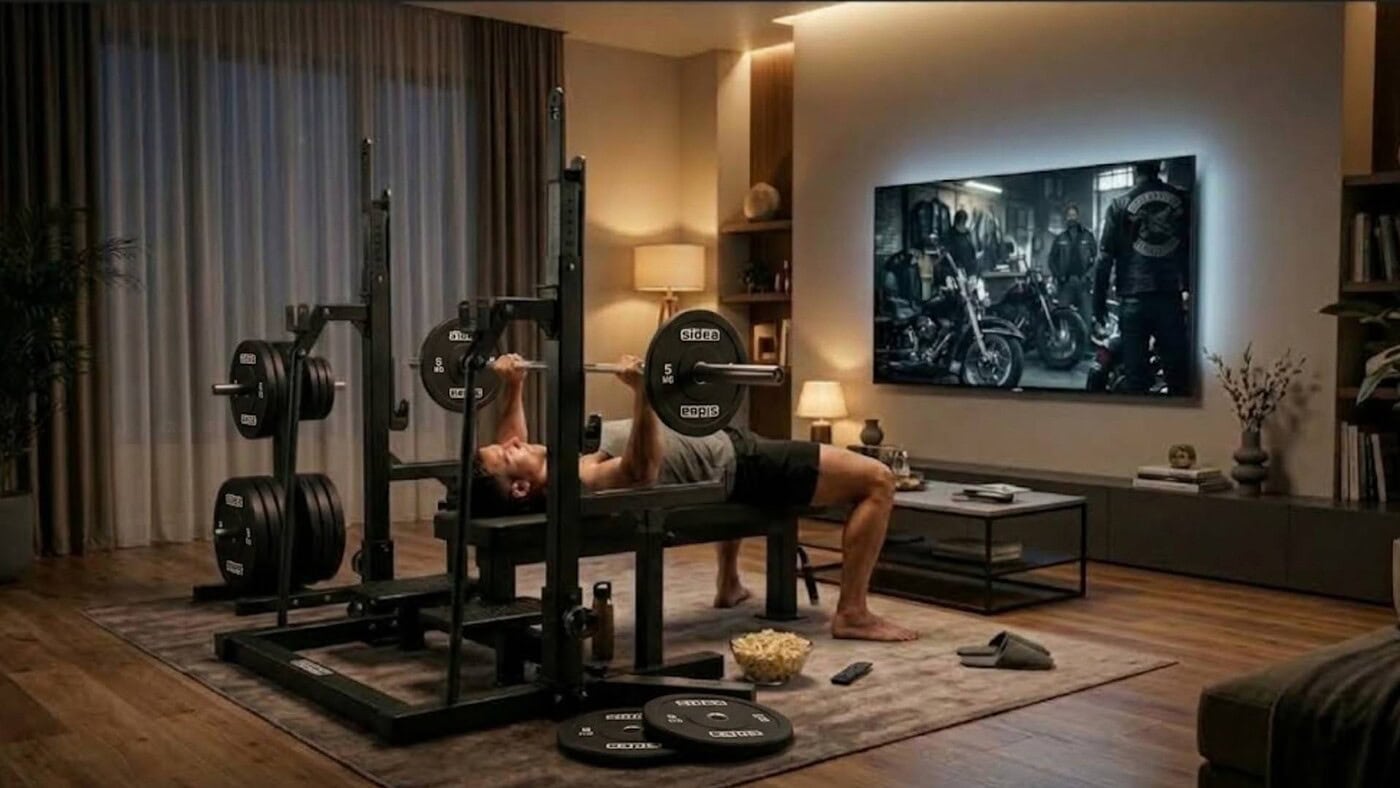
During lockdown, for example, a powerlifting rack had literally taken the place of the sofa in my living room: squats and bench presses between episodes of Sons of Anarchy and the other one.
It might not have been an interior designer’s first choice, but from a training perspective it worked perfectly.
And that is precisely the point: the right solution is not necessarily the one with the most features, but the one that best fits what we actually do.
Limited depth and one wall available: 9095/16 Half Power Cage
In other contexts, the problem is not so much the total surface area as the available depth.
If we have a structurally sound wall, it may be worth using it as part of the structure.
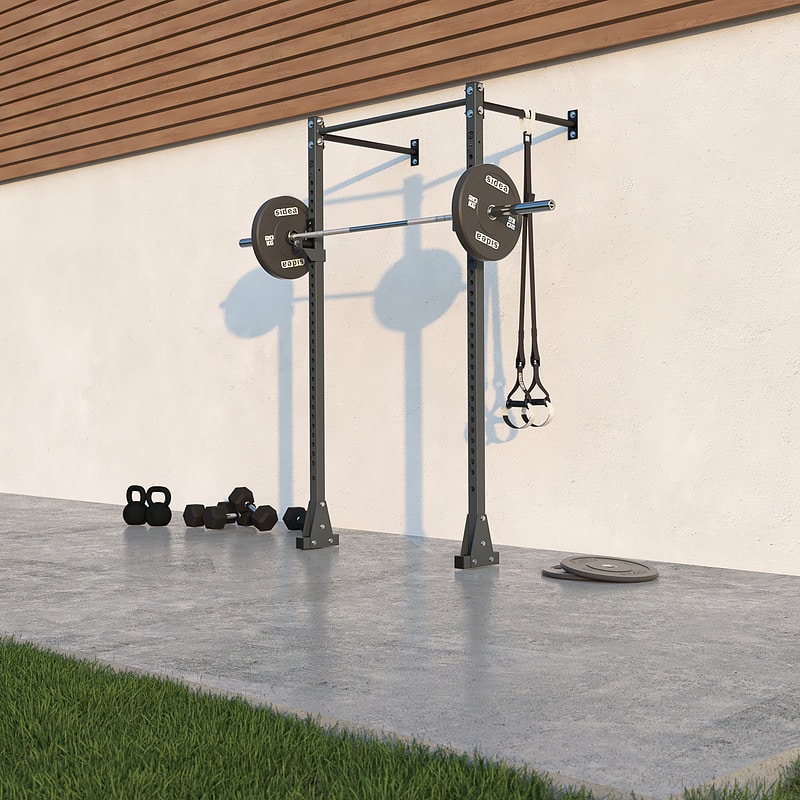
The 9095/16 The Half Power Cage Rack is the wall-mounted version of the Power Cage 9095. It is approximately 230 cm high, features barbell and pull-up bar mounts, and is compatible with flat and adjustable benches. Sidea Fitness
Compared to a full-size cage, it allows you to create a sturdy enclosure whilst taking up less depth.
This solution may be of particular interest to:
personal trainer courses;
home gym;
strength rooms with walls available;
areas where it is necessary to keep a clear passageway.
Of course, there is one important requirement: securing it in place.
A wall-mounted unit must be designed to suit the wall and the room in which it is installed. The height must also be carefully considered: with a unit measuring around 230 cm, it is advisable to allow sufficient clearance to ensure the pull-up bar can also be used correctly.
If we cannot or do not wish to use the wall, we must find another solution.
Compact yet freestanding: 9098/1 Standing Rack Pro
The 9098/1 Standing Rack Pro is designed precisely to meet this need.
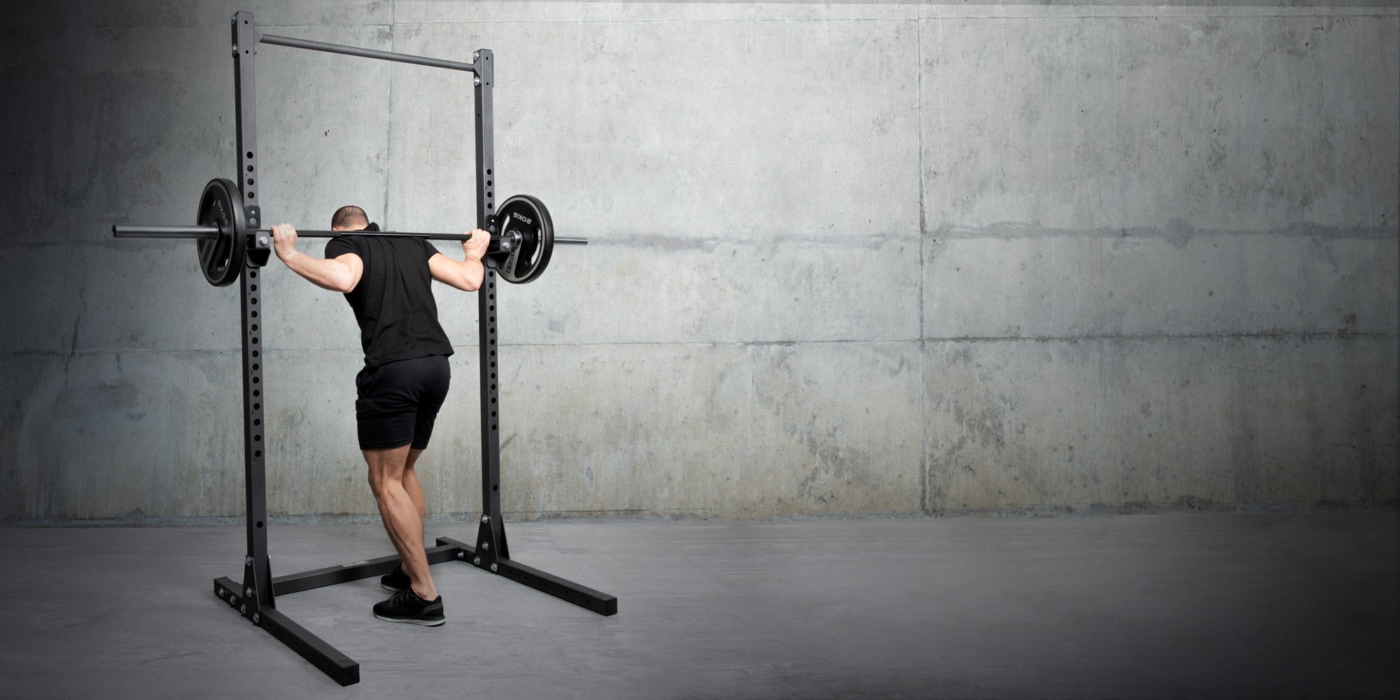
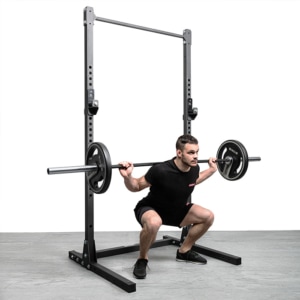
It has a relatively compact footprint — approximately 1200 × 1110 mm — but it is a freestanding structure and can be used for squats, pull-ups and various strength exercises, particularly when combined with a bench. Sidea Fitness
It is a particularly interesting solution when we are looking for a compromise between:
footprint, stability and versatility.
Compared with the two 9045/1 supports, we lose some of the ease of handling, but we gain a unique, more stable and comprehensive structure.
It is therefore well suited to:
advanced home gyms;
personal trainer courses;
small strength training rooms;
individual workstations within a gym.
The principle is simple:
9045/1 if the priority is to free up space.
9098/1 if your priority is to have a compact yet stable workstation.
When you want to work inside the rack: 9095 Power Cage
With a Power Cage, the very way you use the structure changes.
The 9095 The Power Cage Rack is a complete cage featuring four uprights, adjustable barbell supports and the option to train both inside and outside the structure. The rack is freestanding, although SIDEA recommends securing it to the floor where possible. Sidea Fitness
Here, the rack is no longer simply a place to rest the barbell.
It becomes a proper workspace.
This gives you greater freedom to organise:
squat;
bench press;
pull-ups;
military press;
strength training exercises;
complementary accessories.
For a professional weight room or a home gym where space can be permanently set aside for training, the Power Cage is one of the most comprehensive and traditional set-ups.
On the other hand, if every centimetre of depth is precious, or if the room needs to be reconfigured constantly, it might be a more substantial structure than is necessary.
Intensive professional use: High Performance Rack
As the frequency of use, the number of users and the need for customisation increase, the structural requirements also change.
This is where the High Performance Rack range comes in.
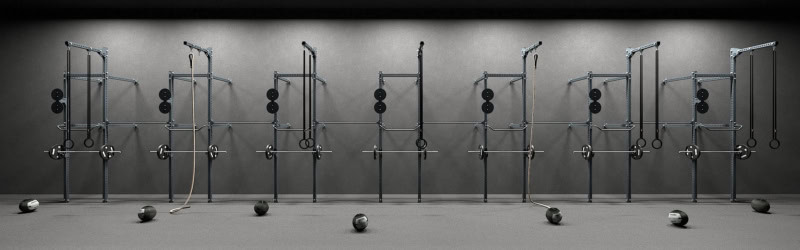
This range is built around 80 × 80 mm uprights and is designed for intensive strength and power training. The structures can be customised using a wide range of components and accessories, making them suitable for gyms, training centres, personal training centres and various strength training disciplines. Sidea Fitness
The 9300M0 The High Performance Cage Rack retains the full cage configuration and is fitted with J-hooks and dedicated safety systems. Sidea Fitness
The 9300M8 The H.P. Standing Rack, on the other hand, takes the concept of a standing rack further by offering a more structured, professional configuration, complete with numerous storage units and accessories; in this case, floor mounting is required. Sidea Fitness
These solutions are particularly useful when the rack needs to be used repeatedly throughout the day and is intended to form an integral part of the room’s infrastructure.
For a basic home gym, on the other hand, they might simply offer more structure and versatility than is actually needed.
When one rack is no longer enough: the 9080 and 9088 All-In-One Racks
So far, we have focused mainly on the barbell.
But there is another question:
What if we also wanted to fit cables and Multipower in the same space?
In this case, it falls into the category of All-in-One Racks.
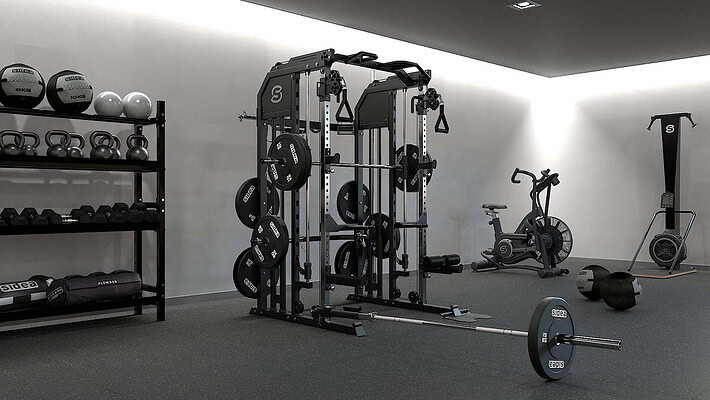
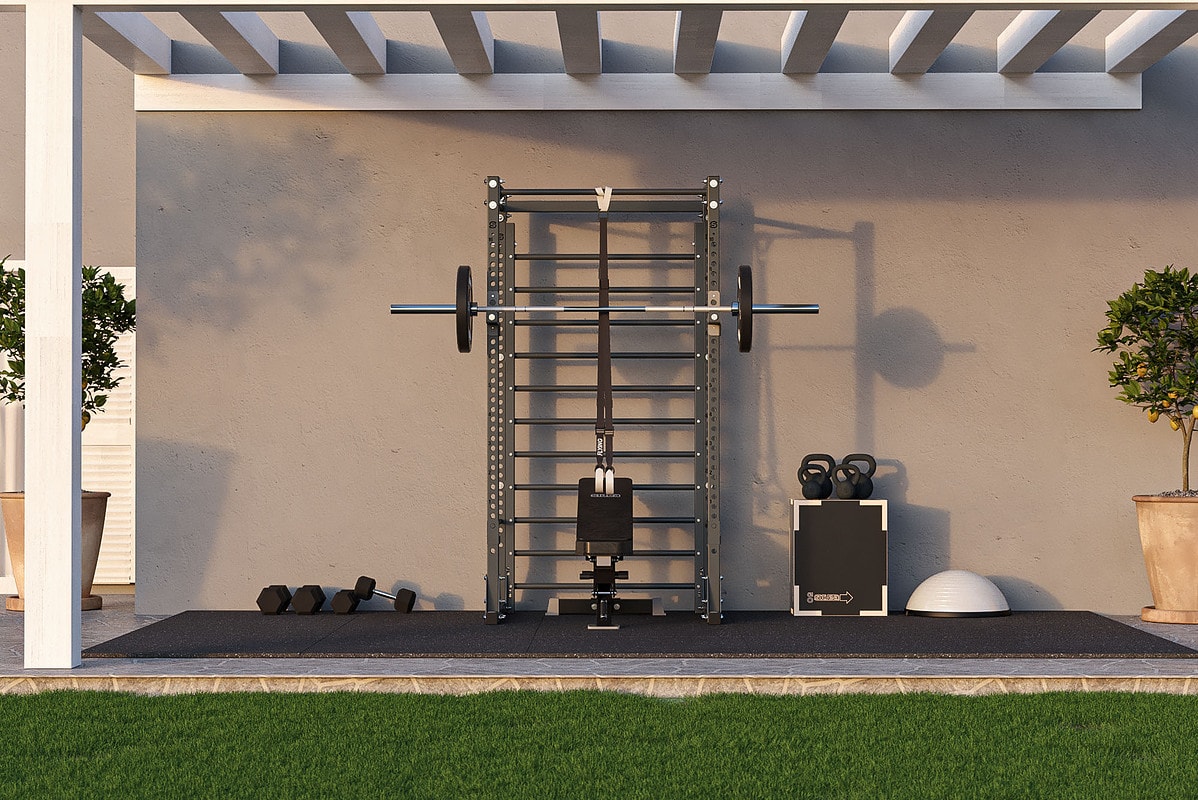
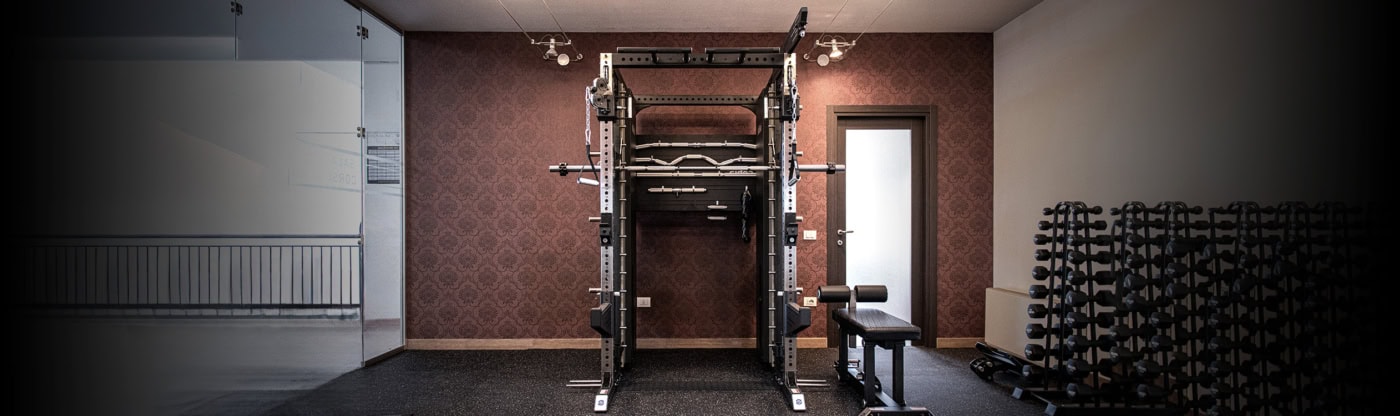
The 9080 The All-In-One Rack combines a rack, Multipower and cable systems in a compact structure, designed for strength training, athletic conditioning and advanced home gyms. SIDEA recommends it particularly for gyms, personal training studios and spaces where a wide range of training options needs to be concentrated within a limited area. Sidea Fitness
The 9088 The Premium All-In-One Rack takes this concept to an even more professional level, with a sturdier frame and two 90 kg weight stacks integrated into the cable systems. SIDEA in fact highlights it as being particularly suitable for commercial gyms with high footfall, where speed of load change and continuous use are key factors. Sidea Fitness
In this case, the question is no longer simply:
“Which rack should I choose?”
but:
“Do I want a rack, or do I want to combine several training stations into a single unit?”
That is a significant difference.
Which rack should you choose? A quick guide
The choice can be summarised by starting with the main requirement:
Requirement
Option to be considered
Compact design and the ability to move the equipment
The most comprehensive rack isn’t always the right one
One of the most common mistakes when designing a gym is to start directly with the product.
When you see a very comprehensive range, you automatically assume it’s the best choice.
In fact, the process should be exactly the opposite.
First, let’s define:
space, users, activities, frequency of use and mounting options.
Next, let’s choose the rack.
Sometimes the answer will be a Power Cage.
Sometimes an all-in-one.
Sometimes a high-performance structure.
And in some cases, the best option will simply be two supports which, once the workout is over, can be moved to a corner.
The SIDEA range comprises a wide variety of systems, precisely because the environments and people who will be using them vary: from Smart Racks to Rack Stations, and from High-Performance models to All-in-One systems. Sidea Fitness
True design, therefore, does not consist of cramming as much equipment as possible into a room.
It involves putting l‘the right equipment in the right place.’.
Do you need help choosing a rack?
Whether you’re planning a home gym, a personal trainer’s studio, a strength training room or a professional gym, you can start with three very simple points:
the size of the space, the available headroom and the type of workout you want to do.
Based on this information, it is possible to determine whether a mobile solution, a Standing Rack, a Power Cage, a High-Performance structure or an All-in-One system would be the most suitable option.
The aim is not to choose the largest rack.
It means designing a workstation that is actually used, every day, in the way it was intended.
In summary
Sidea offers a range of strength training racks to suit a variety of needs: from the 9045/1 Olympic Bar Support Pro, a portable rack for multi-purpose spaces, to the 9045 Powerlifting Rack, designed specifically for squats and bench presses, right through to the High Performance range with 80×80 mm uprights for intensive professional use. The choice depends on the space available, mounting options, the number of users and the type of exercises. Wall-mounted racks such as the 9095/16 minimise depth, whilst All-In-One models such as the 9080 and 9088 incorporate a barbell, Multipower and cable systems.
Domande frequenti
A power rack is a full-size cage with four uprights, allowing you to train within the structure with greater safety and versatility. A half rack (or half-size rack) uses two uprights and is often wall-mounted; whilst it takes up less depth, it offers fewer movement options and fewer attachment points than a full-size cage.
It depends on how the space is used. A mobile rack such as the 9045/1 Olympic Bar Support Pro allows you to clear the room after your workout and is ideal for multi-purpose home gyms or personal training studios that frequently reconfigure the layout. A fixed rack, such as a Power Cage or a High Performance frame, offers greater stability and versatility but requires a permanently dedicated space.
A standard Power Cage such as the 9095 is approximately 230 cm high. It is also necessary to allow sufficient headroom to use the pull-up bar safely: a minimum ceiling height of 260–270 cm is recommended to prevent the athlete from hitting the ceiling during pull-ups or overhead movements inside the rack.
Yes, by using specialised racks fitted with Safety Spotters. The 9045 Powerlifting Rack, for example, is designed for squats and bench presses with dedicated safety systems and can be integrated with benches using specific anchor points. The Safety Spotters allow you to perform bench presses safely even without a full cage.
An All-In-One Rack combines a barbell rack, a Multipower machine and cable systems into a single unit. Solutions such as the 9080 or the 9088 pack a wide range of training options into a compact space and are ideal when you want to train with free weights, guided weights and cable machines without having to increase the number of stations. It is ideal for commercial gyms, state-of-the-art personal training studios or home gyms where maximum versatility is required within a limited space.
80×80 mm uprights, such as those in Sidea’s High Performance Rack range, offer greater structural strength and are designed for intensive use; they can withstand greater structural loads, thereby increasing the flexibility of the structure. Racks with slimmer uprights are suitable for domestic use, home studios and professional settings, but offer fewer configuration options.
A wall-mounted rack such as the 9095/16 Half Power Cage can be just as safe provided the wall is structurally sound and it is fixed correctly. Safety depends on the quality of the wall (load-bearing, solid masonry or reinforced concrete) and the type of anchoring used. If there are any doubts about the strength of the wall, a freestanding rack is the safest option.
If your training focuses mainly on squats and bench presses, a dedicated rack such as the 9045 Powerlifting Rack offers optimised geometry, supports and safety features for these lifts. A general-purpose Power Cage such as the 9095 offers greater versatility for pull-ups, military presses, supplementary exercises and modularity with accessories. The choice depends on whether your training is specialised for the big lifts or requires a multi-purpose setup.
The evolution of HYBRID training In recent years, competitive fitness has evolved towards formats that are increasingly [...]
18 Jun
A spine-tingling Fridaytermina tra 1:00:00
A treat or a workout? Order by 21:00 and you’ll get a 10% discount on your next purchase.
For orders of at least €300 placed within the next hour. The code will be sent by email once payment has been received and is valid until 31 December 2026.
We use technologies such as cookies to store and/or access device information. We do this to improve the browsing experience and to show (non-)personalised ads. Consent to these technologies will allow us to process data such as browsing behaviour or unique IDs on this site. Failure to consent or withdrawal of consent may adversely affect certain features and functions.
Functional
Always active
Technical storage or access is strictly necessary for the legitimate purpose of enabling the use of a specific service explicitly requested by the subscriber or user, or for the sole purpose of carrying out the transmission of a communication over an electronic communications network.
Preferences
Technical storage or access is necessary for the legitimate purpose of storing preferences that are not requested by the subscriber or user.
Statistics
Technical archiving or access that is used exclusively for statistical purposes.Technical storage or access is used solely for anonymous statistical purposes. Without a subpoena, voluntary compliance by your Internet Service Provider, or additional records from third parties, information stored or retrieved for this purpose alone cannot usually be used for identification purposes.
Marketing
Technical storage or access is necessary to create user profiles to send advertisements, or to track the user on one website or several websites for similar marketing purposes.












 9088K1 All-in-One Rack Premium LIGHT PACK
1 × 5.491,53€








 Defibrillator AED
 Gift CardSidea
 Spare parts