















For the first time in the history of fitness, training the buttocks has been the protagonist of numerous scientific studies. The world of research, of which I myself am a part, has finally become interested in the sphere of overload training and the impact this can have on theaestheticsas well as on performance.
In this regard, the question everyone asks is always the same: "What is the best exercise?"
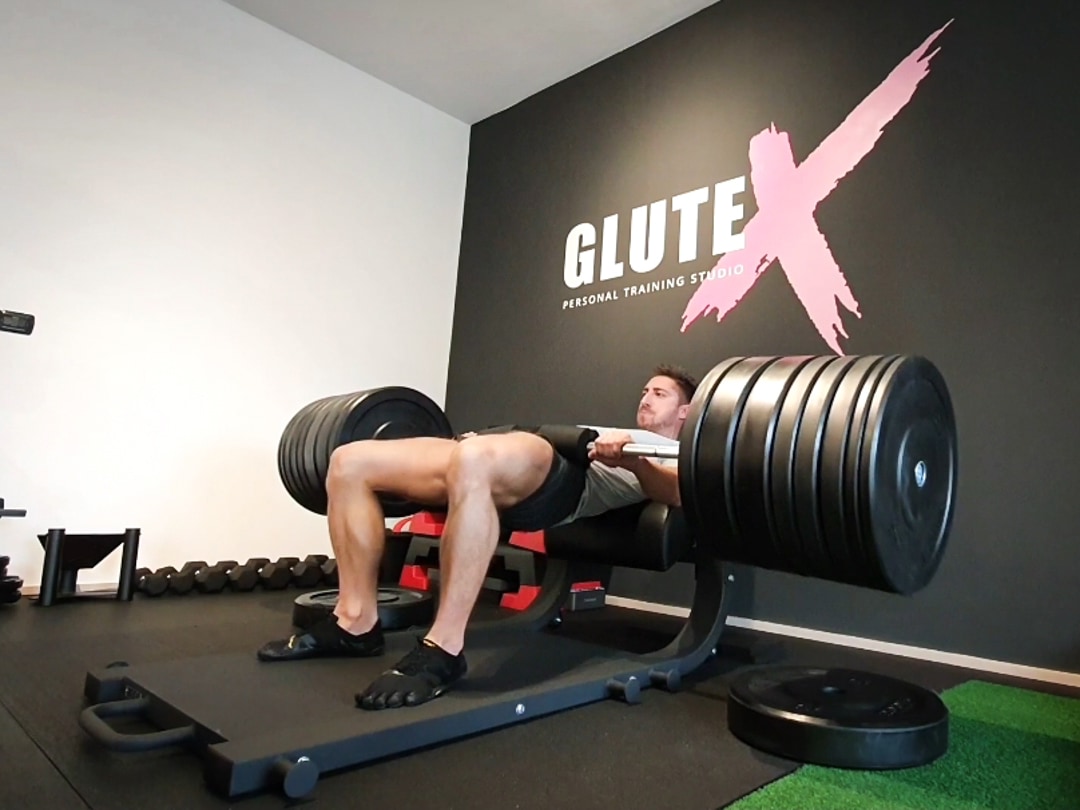
Before coming to hasty conclusions, let me state that there are no better exercisesbut there are profits and of less useful. And this applies to all muscle groups: if you want maximum pectoral development, you cannot just do the flat bench but it is also necessary to work on inclined planes and with horizontal adduction movements. If you want a wide and thick back, the deadlift can help but on its own it is not enough, you will also need to perform pull-ups, pull-downs and rowing. This obviously also applies to the buttocks: it is not possible to think that only the squat will sufficebut it will be necessary to implement movement variants on all floors performing exercises such as hip thrust and abductions.
The functions of the buttocks
Lo squatsuch as the deadlifts and the lunges, are very good exercises. However, they only ever work on thevertical hip extension and we know that the buttocks, in addition to being three distinct muscles (small, middle and large gluteus), also have different functions:
- Hip extension
- Hip abduction
- External hip rotation
- Retroversion of the pelvis (actually, this movement, as far as the femoral head and acetabulum are concerned, can be associated with hip extension)
Precisely because the buttocks have all these functions, it is very useful to include in the training programme exercises involving all of them. Obviously, the training methodology must be suitable for each of them, as some movements lend themselves better to high loads while others to low loads, or even the use of auxotonic resistances such as the elastic bands.
-40%
PROMOTION
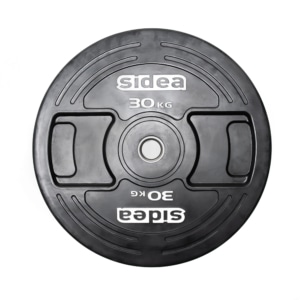
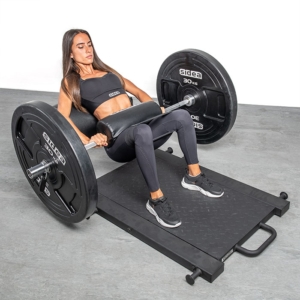
Rubberized bumper plates - Bumper plates PU
-20%
Promotional kit
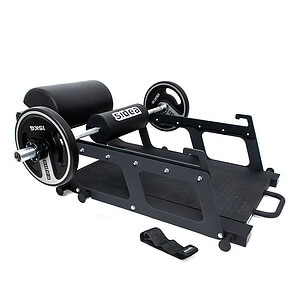
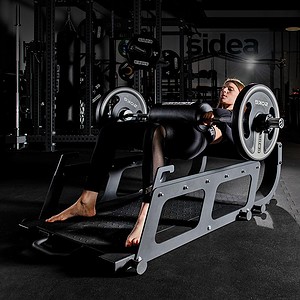


Muscle hypertrophy
This is where the three main factors for themuscular hypertrophy:
- Mechanical tensionApply a progressive overload on exercises such as squats, hip thrusts and deadlifts to increase mechanical tension.
- Muscle damageUse one-sided exercises such as lunges, b-stance hip thrusts and single-leg pull-ups to emphasise muscle damage.
- Metabolic stressHorizontal hip extensions against gravity and abductions, e.g. hyperextensions or exercises with an elastic band to exacerbate metabolic stress.
A further measure could be to implement the retroversion of the pelvis in exercises in which maximum gluteal tension occurs when the muscle is in maximum shortening. It is therefore excellent in hip thrusts and variations, but also in classic/inverse hyperextensions, as well as in the closing phase of the various floor presses.
Scientific studies and research
There are currently many studies concerning thegluteal activation in the various exercises, investigated by means of EMG (electromyography). This examination gives a precise indication of the nerve stimulation of a certain district, however, it does not imply the superiority of one exercise over another as other factors come into play such as ROM (Range Of Movement), TUT (Time Under Tension), PT (Peak Tension) and much more.
Analysing some studies, we can see that Contreras' team in 2015 highlighted how thehip thrust ports twice as much muscle activation of the gluteus maximus as in the squat.
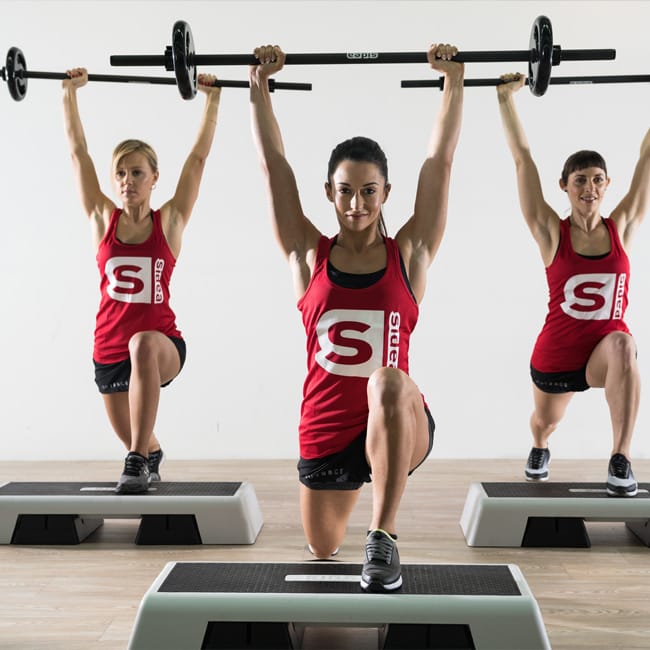
Again, the 2018 study by Mc. Curdy et al. highlighted how well split squats are superior to the classic squatin relation to gluteal activation. A 2018 study by Barbalho et al., the first to investigate the increase in muscle mass and not just EMG, showed how the hypertrophy of the gluteal region was much greater by performing squats rather than hip thrusts. Unfortunately, however, shortly after its publication, it was shown by exponents such as Layne Norton and Greg Nuckols how the study was piloted.
Conclusions
In general, we can therefore state that training for the buttocks must be varied in both type and stimulus. Only in this way can we be sure of working effectively. Below is an example of a training session involving the three gluteal muscles with all their functions:
- Squat barbell: 4 x 6
- Hip thrust barbell with retroversion: 3 x 8-10
- Bulgarian split squat handlebars3 x 12 per side
- Romanian Stacks barbell: 2 x 15
- Quadrupedal abductions with elastic band2 x 20 per side
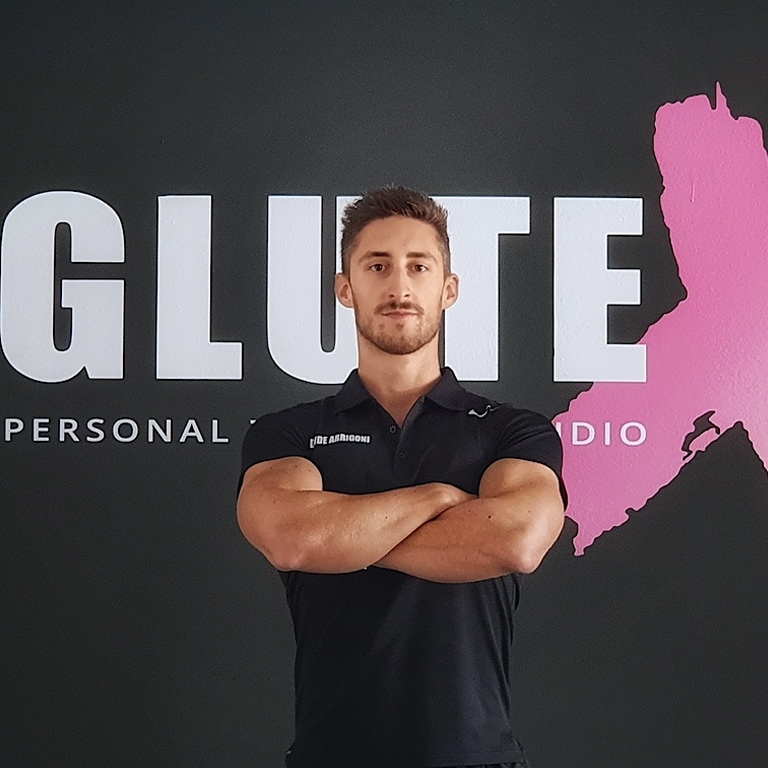
Davide Arrigoni
- Expert in female training and bodybuilding
- Owner of the GluteX personal training studio
- Exercise Science graduate and ISSA USA Elite Trainer


 Defibrillator AED
 Gift CardSidea
 Spare parts