















NORDIC HAMSTRING CURL
An exercise used in fitness, athletic training and sports medicine, the Nordic Ham Curl has become one of the most widely used movements in injury prevention.
Also called the Russian leg curl, or reverse curl, this is a simple knee flexion-extension, however the tension is generated not by moving an external overload, but by moving one's own body in space.
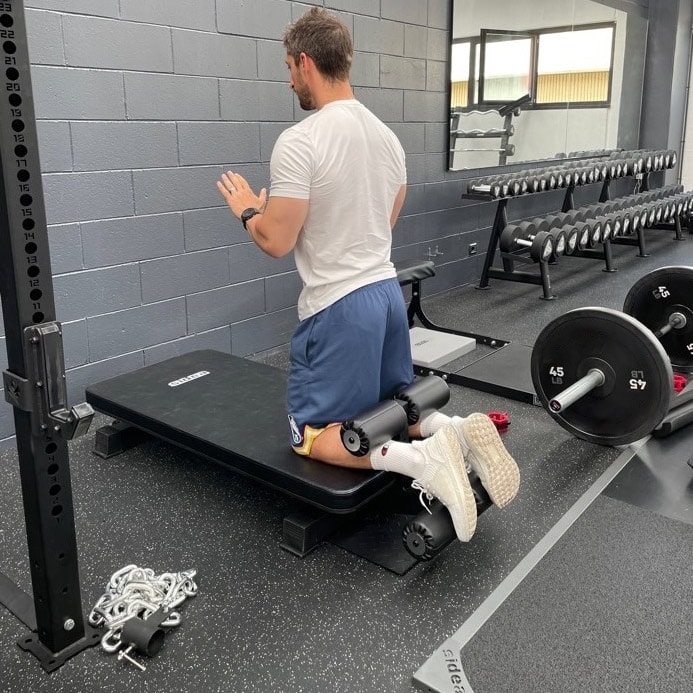
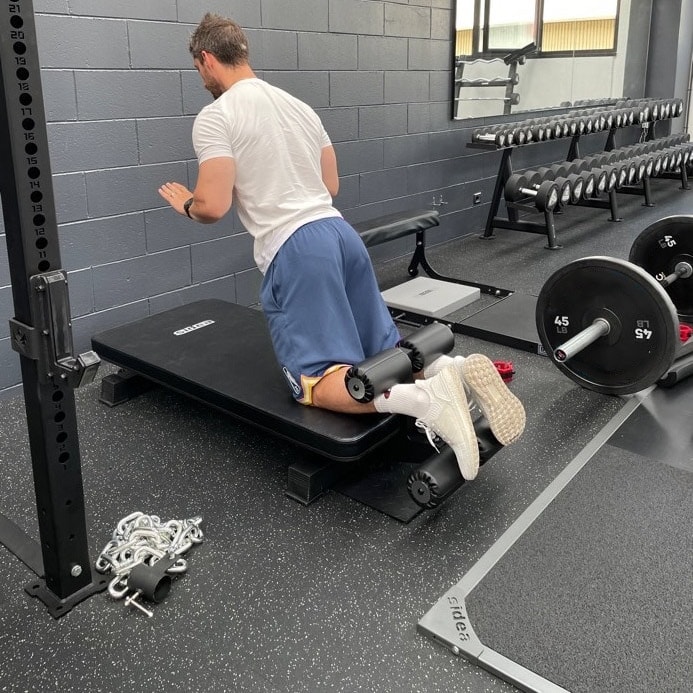
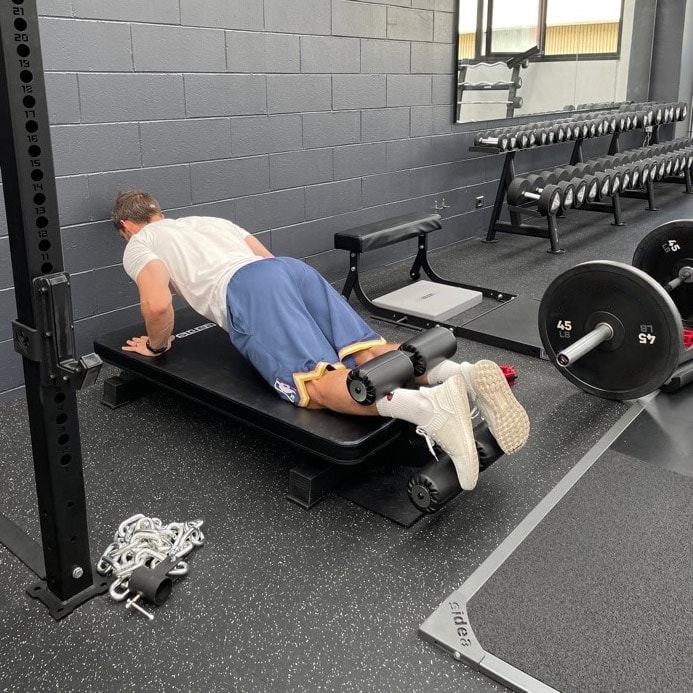
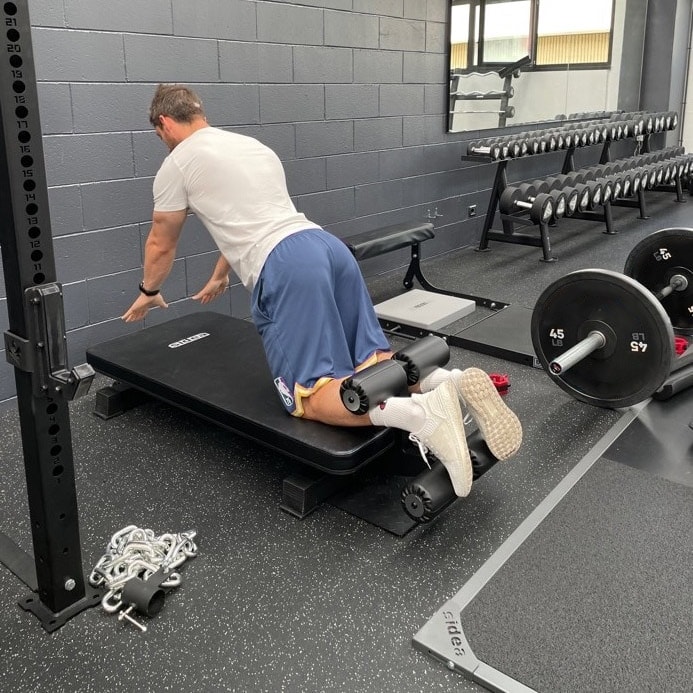
The exercise is performed by kneeling on a pad with the torso straight, securing the feet under a stable support such as a barbell, lat machine pads, a wall bar or simply held on the floor by a partner. From this position, you lower your torso towards the ground, trying to brake your descent.
ACCIDENT PREVENTION
The Nordic Hamstring Curl is one of the most widely used exercises for the prevention of stretch injuries to the posterior thigh muscles, as well as one of the most referenced in the scientific literature along with the squat, Olympic lifts and deadlifts. The NHC is believed to be one of the best exercises for this purpose due to its biomechanics and especially its resistance profile, or resistance profile. In fact, unlike variations of the leg curl with cam machines (weight stack) where the maximum tension occurs at the moment of maximum muscle shortening, in the NHC this tension corresponds to the maximum elongation of the fibres of the posterior thigh muscles.
This makes the exercise predominantly eccentric in nature and this is very beneficial in disciplines such as skiing, snowboarding, football, basketball, athletics and many others where the athlete is 'forced' to perform movements that place joints and muscles under maximum stress in a very short time.
INCREASED PERFORMANCE
There are dozens of studies concerning the correlation between this exercise and the prevention of injuries for sportsmen and women. In fact, the moment of force expressed during knee flexion is strongly correlated with the speed of the sprint. Precisely in sprinting, the posterior thigh muscles contract both to extend the hips and to flex the knees to create forward propulsion. It follows that training the knee flexion movement, with a different resistance profile than with classic machines, can also be very useful for increasing performance in sprints and horizontal jumps.
An important clarification must be made. Performing NHC, and thus increasing the eccentric force in knee flexion, does not a priori prevent injury. In fact, it has been seen that injury to the knee (and related muscles) is related to multiple factors such as flexibility, strength, fatigue, core stability, and any previous injuries.
An athlete may possess plenty of strength to absorb eccentric stress, high levels of flexibility in the hamstrings so that he or she can stretch sufficiently during a sudden overload, but still incur an injury due to excessive fatigue (e.g. mid- to end-of-competition), or a previous injury.
NEUROMUSCULAR ACTIVATION
The NHC is an exercise that is increasingly used in fitness and bodybuilding to increase muscle mass in the posterior thigh muscles. In various studies, the results in terms of muscle activation investigated by means of electromyography (EMG) surpassed the seated leg curl, semi-stretched leg lifts and good mornings.
It is therefore certain that NHC brings high levels of activation of the posterior thigh muscles and should therefore be included in a complete protocol in combination with other exercises such as semi-stretched leg lifts, glute ham raises and leg curls on the machines.
EXERCISE SETUP
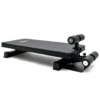
One of the biggest problems in performing this exercise is undoubtedly the difficulty of the initial positioning, or setup. In fact, finding a comfortable and safe position in a commercial gym, as well as in a home gym, becomes complicated. The station created by Sidea allows the exercise to be performed without having to load any barbells to stabilise oneself, nor to look for a pad that is soft enough not to hurt one's knees.
The station is immediately ready and adjustable for every type of user. Its heavy weight guarantees a great deal of stability even for the heaviest athlete or for abrupt movements such as the last eccentric phase of the NHC movement, where there is a tendency to let go due to the above-limit tension when the femur is almost parallel to the ground.
ROMANIAN CHAIR SQUAT
Actually, this station was not only designed for the NHC, but also for the movement of the Romanian Chair Squat, or Roman Bench Squat. This exercise, which later became known (erroneously) as the Sissy squat, places the quadriceps under great tension even without the aid of overloads.
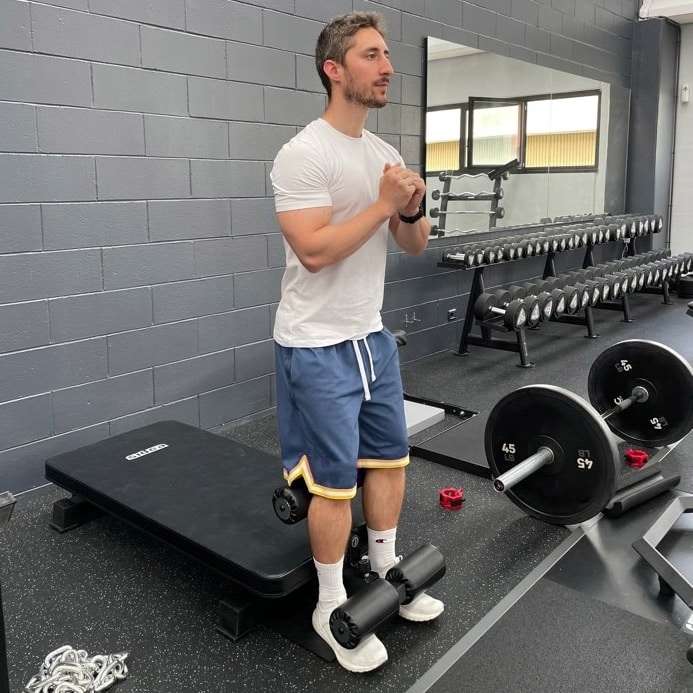
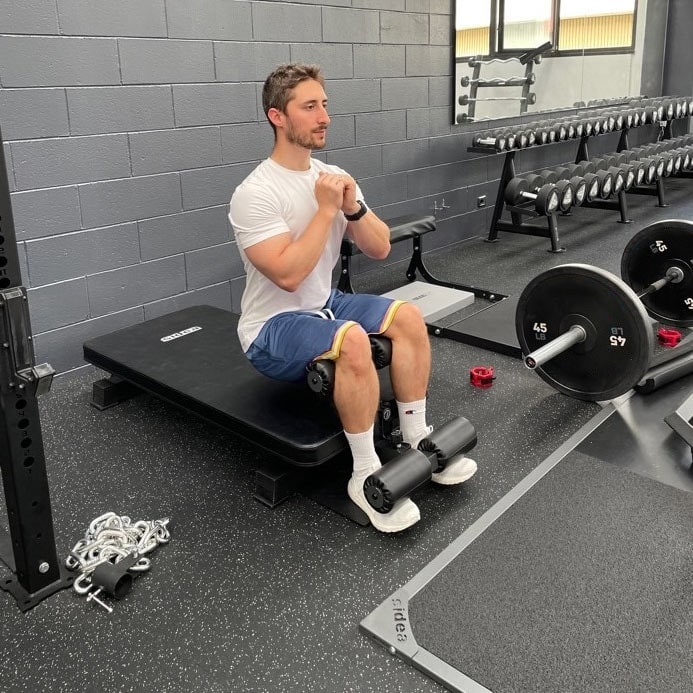
However, along with the muscles, the patellar tendon is also under a great deal of strain and therefore this movement must be used carefully. However, there are cases in which this exercise becomes extremely useful, almost essential. In sports such as skiing or snowboarding, the constrained position of the knees is very similar to that of the Romanian Chair Squat, with the difference that the tension is much greater as this position is reached at very high speeds or following landings and/or changes of direction.
PROGRESSIVE APPROACH
To prevent hamstring injuries, as well as to increase performance, incorporating RCS into the training protocol can be a very smart choice, especially when combined with exercises such as barbell squats, single-leg squats, and hamstring extensions on machines. To avoid injuring the patellar tendon or anterior cruciate ligament, two types of progressions must be performed:
- Range of motion: start with a shorter movement and then move downwards over the course of the workout
- Overload: start free-body and then use an overload, only if the range of motion is complete (otherwise work on that first)
CONCLUSIONS
The workstation created by Sidea is extremely comfortable due to its immediacy of use and simplicity, as well as very stable and safe for all types of users. Moreover, the wide range of exercises that can be performed such as Nordic Hamstring Curl, Romanian Chair Squat or Bulgarian Split Squat also makes it versatile as a multi-exercise station.
-
 9123 Ghd & Sissy Squat - Hamstring Bench
455,98€ FEES and TAXES NOT INCLUDED
9123 Ghd & Sissy Squat - Hamstring Bench
455,98€ FEES and TAXES NOT INCLUDED
REFERENCES
- Attar, W.s.a. Al, et al. "Effect of Injury Prevention Programs That Include the Nordic Hamstring Exercise on Hamstring Injury Rates in Soccer Players: A Systematic Review and Meta-Analysis." Journal of Science and Medicine in Sport, vol. 20, 2017, doi:10.1016/j.jsams.2017.01.124.
- Attar, W.s.a. Al, et al. "Effect of Injury Prevention Programs That Include the Nordic Hamstring Exercise on Hamstring Injury Rates in Soccer Players: A Systematic Review and Meta-Analysis." Journal of Science and Medicine in Sport, vol. 20, 2017, doi:10.1016/j.jsams.2017.01.124.
- Brukner, Peter. "Hamstring Injuries: Prevention and Treatment-an Update." British Journal of Sports Medicine, vol. 49, no. 19, 2015, pp. 1241-1244., doi:10.1136/bjsports-2014-094427.
- Cameron, Matthew L., et al. "Effect of the HamSprint Drills Training Programme on Lower Limb Neuromuscular Control in Australian Football Players." Journal of Science and Medicine in Sport, vol. 12, no. 1, 2009, pp. 24-30., doi:10.1016/j.jsams.2007.09.003.
- Presland, J., et al. "The Effect of High or Low Volume Nordic Hamstring Exercise Training on Eccentric Strength and Biceps Femoris Long Head Architectural Adaptations." Journal of Science and Medicine in Sport, vol. 20, 2017, p. 12., doi:10.1016/j.jsams.2017.09.213.
Davide Arrigoni
- Expert in female training and bodybuilding
- Owner of the GluteX personal training studio
- Exercise Science graduate and ISSA USA Elite Trainer



 Defibrillator AED
 Gift CardSidea
 Spare parts