Big Tubing: A Complete Guide
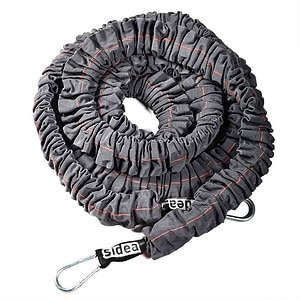
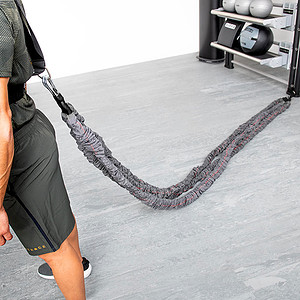
Big Tubing are elastics large-diameter tubular bars with handles or end rings, used for resistance running, controlled sprints, lactic acid strength training exercises and drills for agility. Sidea offers two versions: ‘Easy’, with a resistance of around 30 kg, for post-injury return-to-play programmes, mixed-ability groups and beginners; and ‘Power’, with 60 kg of resistance, for athletes performing controlled running, four-step resistance drills, jumps and ascents onto raised platforms. The system is completed by a belt with a attachment loop and a strap for securing it to a partner or fixed structures. Those looking for a wider range of resistance levels may also consider the elastic bands and resistance bands from the catalogue.
What is Big Tubing: definition and function
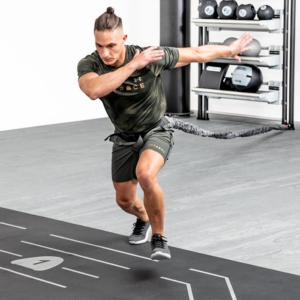
Big Tubing is a high-profile tubular latex rubber band, with metal or fabric ends that allow it to be attached to belts, laces or carabiners. Unlike flat bands, the circular cross-section ensures a more linear force-elongation curve over the first 200–300% of elongation, which is useful in resistance sprint training where constant resistance is required during acceleration. In strength and conditioning practice, the tubing is secured to the athlete’s hips via a padded belt and held in place by a partner or fixed to a stable anchor point. The athlete then performs forward, lateral or backward running, or jumps against the resistance of the elastic band, generating neuromuscular overload specific to the acceleration phase.
Types of Big Tubing
Easy Big Tubing 30 kg
The medium-low resistance version is designed for pre-season training and returning to action after injury, beginners and technical drills where speed of execution is more important than the load. It allows for lateral running, retreating, four-point support, jumps with both feet together and climbing onto raised platforms whilst maintaining good motor control. It is the entry-level tool for building progression before moving on to the Power version.
Power Big Tubing 60 kg
Twice the resistance of the Easy model; used with trained athletes in contexts such as controlled running, resistance sprints and strengthening of the horizontal push-off phase. The 60 kg load works well for individuals weighing over 70–80 kg who are seeking intense neuromuscular stimulation during the initial strides.
Complete Easy and Power kits
The kits include Big Tubing elastic, a belt with a attachment ring and a strap for securing to objects. Ready-to-use set-up for individual sessions with a partner or a fixed anchor point, with no need to assemble separate accessories.
Belt and fastening strap
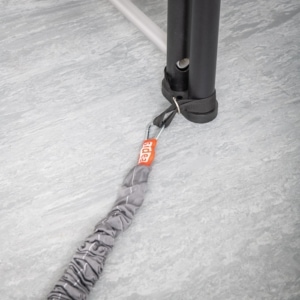
ComponentThese are available separately for those who already own the elastic cord or wish to set up multiple stations at the same time. The padded belt distributes the tension across the pelvis, whilst the strap allows the elastic cord to be attached to poles, columns or fixed structures when a partner is not available.
How to choose: a guide to use cases
Gyms and sports centres
Those working with a mixed group of users – ranging from the over-60s to young competitive athletes – should start with the Easy Big Tubing for beginners and use the Power alongside it for those undertaking specific athletic training. Two or three Easy bands used in parallel roughly replicate the load of a single Power band, offering flexibility in how they are combined.
PT practices and athletic trainers
For individual training with team sport athletes (football, rugby, basketball, hockey), the Power is the first choice. It should be used over short distances – 5–15 metres – with ample recovery periods so as not to compromise the quality of the sprint. The padded belt is essential to prevent injury to the pelvis during repeated sets.
CrossFit and functional training studio
Tubing is incorporated into EMOM circuits or used as an additional stimulus for carries, sled push variations and resistance jumps. For combined exercises with sleds, also consider the SLED towing sledges, which complement tubing exercises in horizontal power training.
Advanced home and garage gym
An Easy Big Tubing set, complete with a strap for securing it to a garden post or the rack frame, meets 90%’s requirements for independent strength training. Those who train alone appreciate how easy it is to set up compared to other resistance systems.
Technical glossary
- Restrained run
- A sprint exercise performed against external resistance (elastic band, sled, partner) that increases the load during the horizontal push-off phase. It is used to improve acceleration over the first 10–20 metres.
- A hard-fought sprint
- A variation of the controlled run with loads calibrated between 10% and 30% of maximum speed. Above this threshold, the motor pattern deteriorates and the training loses its specificity.
- Force-length relationship
- A curve showing how much the resistance of an elastic band increases as the percentage elongation increases. In high-quality tubing, the curve is linear up to 250–300%, after which it increases exponentially.
- Belt with ring
- A padded belt worn around the hips, fitted with a central or rear metal ring for attaching the elastic strap. It distributes the tension, preventing localised compression.
- Fastening strap
- A cord with loops or carabiners at each end, used to secure the bungee cord to posts, poles, rack structures or fixed points when no partner is available.
- Overspeed training
- A method that is the opposite of the resistance run: the elastic band assists the athlete rather than slowing them down, increasing their running speed beyond their voluntary maximum. It requires long resistance bands and flat surfaces.
- Speed deltoid
- A technical term referring to the group of muscle chains (glutes, hamstrings, triceps surae) responsible for horizontal propulsion during a sprint, which is the main focus of resistance band training.
Comparison of Big Tubing Sidea models
| Model | SKU | Resistance | Recommended use |
|---|
| Easy Big Tubing | 1696 | ~30 kg | Rehabilitation, over-65s, beginners, technical drills |
| Power Big Tubing | 1699/1 | ~60 kg | Resisted sprint, controlled run, competitive athletes |
| Easy Big Tubing Kit | 1695 | ~30 kg | Complete entry-level set including a belt and lanyard |
| Power Big Tubing Kit | 1699 | ~60 kg | A comprehensive programme for advanced athletic training |
| Belt with ring | 1697 | Accessory | Elasticated waistband, padded |
| Fixing strap | 1698 | Accessory | Anchoring to fixed objects or a partner |
Frequently Asked Questions about Big Tubing
The full FAQs on technical applications, choosing between Easy and Power, the number of elastic bands to combine, and maintenance are set out in the dedicated section further down this page.
Why choose Sidea
Sidea has been manufacturing and distributing professional fitness equipment since 1999 from its base in Gambettola, in Romagna. Over 25 years of collaboration with fitness trainers, CrossFit boxes and sports centres have resulted in an essential range, free from unnecessary frills, designed for durability and serious training. The Big Tubing range was developed in response to specific requests from trainers who were looking for tubing with sturdy handles, comfortable padded straps and laces that are truly resistant to repeated pulling. Sidea is an official StrongFirst distributor and Luxiaojun and sponsor of the Summit of Strength StrongFirst is a regular fixture at FIBO. On request, the team provides direct technical advice on setting up functional training areas and offers a Gym Design service with 3D renderings for gyms and boxes.














 0095 Pilates Reformer
1 × 1.220,00€
0095 Pilates Reformer
1 × 1.220,00€ 9080 All-in-One Rack
1 × 1.967,25€
9080 All-in-One Rack
1 × 1.967,25€ 9088/7 All-in-One Rack Premium Foot Plate
1 × 152,50€
9088/7 All-in-One Rack Premium Foot Plate
1 × 152,50€ 9089/2 Add On Load Kit
2 × 108,28€
9089/2 Add On Load Kit
2 × 108,28€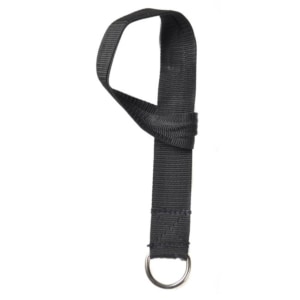 1698 Object fastening strap
1 × 5,34€
1698 Object fastening strap
1 × 5,34€




 Defibrillator AED
 Gift CardSidea
 Spare parts