











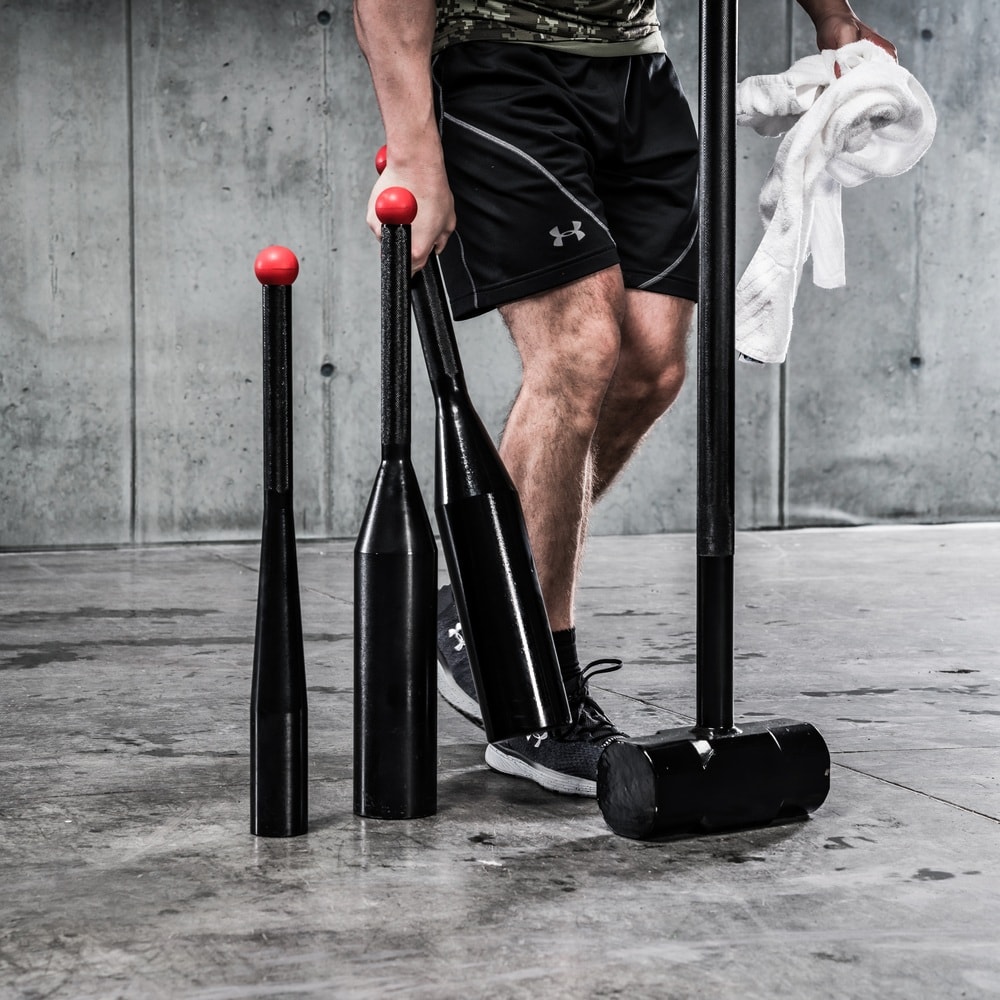


If by now the kettlebell have become commonly used equipment in almost all gyms and sporting contexts, clubs are certainly still largely unknown and consequently little appreciated. Once one has learnt to use them, however, one is immediately able to realise how useful these tools can be in any form of training and physical conditioning, being able to show limits of which one was probably not even aware before using them.
The off-centre mass in relation to the handle makes the tool highly unstable. A first consequence of this characteristic is that from the outset one does not have an immediate understanding of how to move it from the ground: one instinctively comes to lift it by pulling it with one's arms, and this makes one perceive a strange, unstable weight to handle. In some respects, one is surprised at how much a Clava weighing only 7.5 or 10 kg can weigh. Not knowing how to use it in a technical and profitable way, one generally tries to handle it with arm strength, in the same way as a dumbbell.
Another technical shortcoming that often emerges when first using clubs is the grip. In some cases, you suddenly realise how poorly your forearms and grip muscles are trained, so much so that you are unable to close your fingers for hours after the first few sessions. It is precisely these characteristics, however, that are the added bonus of club training, making this tool unique.
Currently the clubs go from 1 kg to 30 kg, range which allows the most varied use in both single and double grip and for every level of training. For a trained man who is used to performing strength work with heavy barbells, for example, a 10 kg single grip club or a 20 kg double grip club are more than sufficient to allow incredible gains in strength, stability and muscular quality. However, clubs are not only used in common aesthetic-functional training in the gym: due to their extreme versatility, they also find unique applications in the field of prevention and rehabilitation, as well as in athletic training.
The structural characteristics of clubs determine their technical characteristics: the weight is strongly off-centre with respect to the portion of the club where the grip is exerted, much more so than tools such as the kettlebell. Unlike the latter, moreover, there is no real grip, but rather a simple section where great force is applied to hold it firmly. This becomes all the more crucial considering that the clubs are not lifted, but rather slung, so they take on great speed during the execution of the exercises and only by means of an excellent grip can one avoid losing control of them and throwing them to the ground.
View this post on Instagram
Off-centre mass and implement momentum are the fundamentals of club training: this simultaneously conditions both grip strength and scapular girdle stability, but during the momentum phase also improves joint mobility in joint decompression and fascial elasticity in the muscle chain.
Here, clubs, properly used, are fundamental in preventing injuries and also in post-injury recovery. Mobility, Stability, Proprioception and Co-ordination are indeed fundamental physical characteristics for both of these training goals, making them valuable tools in the hands of physiotherapists, rehabilitators and athletic trainers.
With clubs, strong, stable and functional shoulders are built in all three planes of movement, making them particularly suitable for sports characterised by fast and powerful arm movements (combat sports, throwing sports, swimming, baseball, golf, tennis, volleyball, sport climbing, etc.). Having said this, by being stretched through the motor fulcrum of the hips and stabilised along all possible trajectories through the trunk (Core Training), clubs can produce useful benefits for all sports, finding application in the general Athletic Preparation of any sport discipline, and through targeted technical combinations can also strongly approach various specific technical gestures.
In particular, clubs allow ballistic momentum work in the three planes of movement, especially in the most important one in the development of the technical actions of all sports, the Transverse Plane. This is the plane of movement that plays a fundamental role both in the prevention of injuries from indirect trauma and dysfunctional stress/overload, and in increasing the reactivity, rapidity, speed and executive power of specific gestures (accelerations, decelerations, changes of direction, specific sports technical executions). Having strong, stable, proprioceptive and reactive joints during rotations and torsions is the key to having healthy and efficient athletes throughout their sports career.
Although they may be underestimated or, due to their constitution, they may be frightening, clubs have unique characteristics that make them extraordinary tools not only in Functional Training, but also in any physical training context, from rehabilitation to physical preparation, and even in purely aesthetic fitness.
On the other hand, only with an optimal knowledge of exercise technique in full respect of the body's biomechanics, and functional training programming, can its extraordinary characteristics be optimised.
by Emilio Troiano
Master Trainer of the WTA International Functional Training Academy
The WTA Functional Training Academy has been training trainers in the use of the Clave since 2009, and from April 2019, in addition to the historical in-house training courses, it is offering the brand new Online training courses rich in practical technical content (over 90 video lessons, ebooks and training sheets), to specialise in the use of the Claves in every physical context, from athletic training to rehabilitation and group training in Functional Training.
Click on the banner below to discover the Clubs Training Instructor Course.
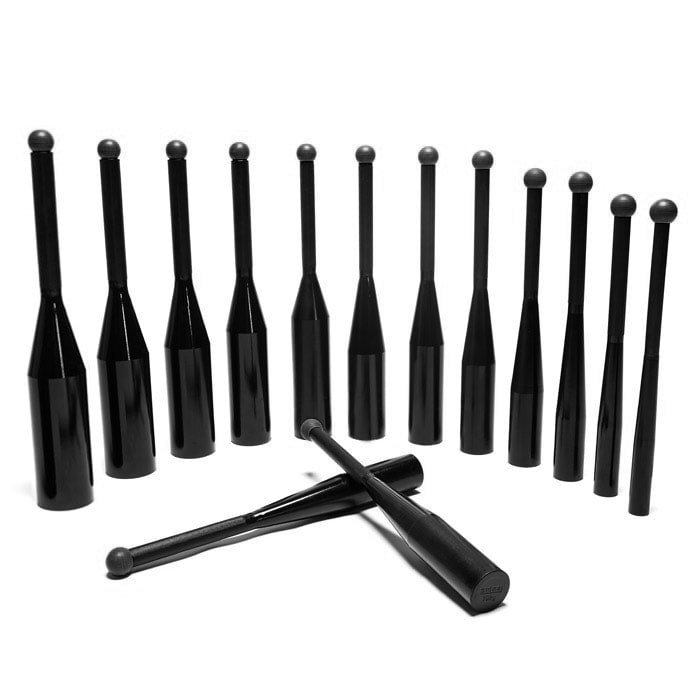
2149-2166 Si-Club
14,49€ 298,90€Fascia di prezzo: da 14,49€ a 298,90€ FEES and TAXES NOT INCLUDED
Produced since 2010, Sidea clubs are a benchmark in clubbell training and rotational functional training.
Made of steel, with medium knurling and a high-strength micaceous finish, they offer high performance thanks to optimised proportions and technical features that improve balance and grip, even in the most dynamic movements.
Available from 1 to 30 kg, they adapt to every level and technical need, promoting the development of strength, mobility and coordination.
SEE ALSO:

 Defibrillator AED
 Gift CardSidea
 Spare parts